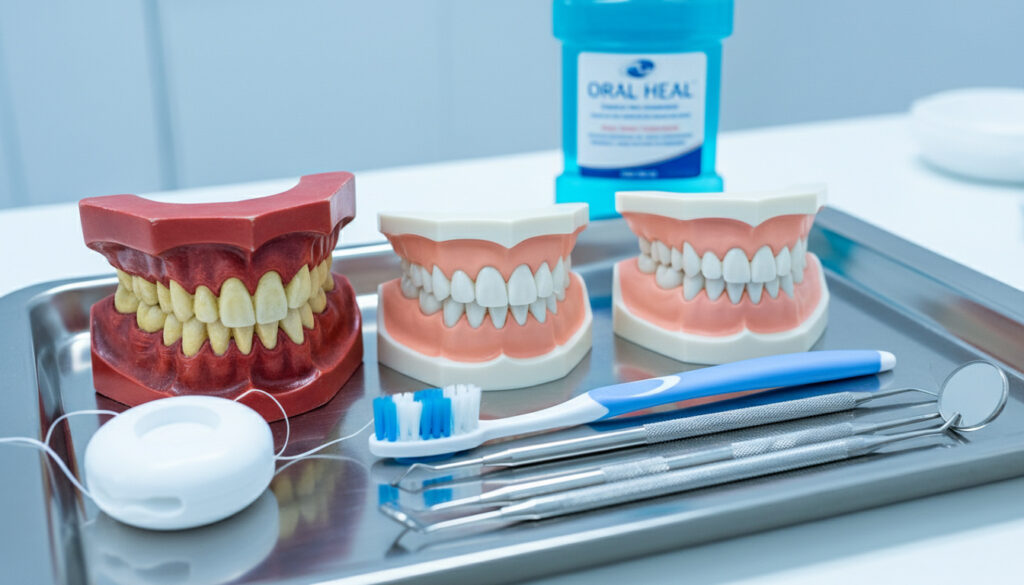
How to Get Rid of Gum Disease – Stages and Proven Treatments
Gum disease affects nearly half of adults over thirty, yet many remain unaware they have it until bleeding gums or persistent bad breath signal trouble. This progressive condition begins with reversible inflammation but can advance to permanent tissue destruction if neglected.
Understanding the distinction between gingivitis and periodontitis determines whether simple home care suffices or clinical intervention becomes necessary. While early-stage disease often responds to improved hygiene, advanced cases require professional procedures to halt damage and prevent tooth loss.
Medical authorities including the CDC and Cleveland Clinic emphasize that treatment success depends entirely on the disease stage at diagnosis and the patient’s commitment to ongoing maintenance.
Can Gum Disease Be Reversed?
Early Stage: Gingivitis
Reversible inflammation without bone loss; responds to brushing, flossing, and professional cleaning.
Advanced Stage: Periodontitis
Requires scaling and root planing; damaged bone cannot fully regenerate.
Daily Prevention
Twice-daily brushing, daily flossing, and smoking cessation form the foundation of control.
Warning Signs
Persistent bleeding, gum recession, and loose teeth indicate immediate professional evaluation needed.
- Gingivitis reversal occurs within weeks using proper hygiene and routine cleanings before bone loss develops.
- Periodontitis causes irreversible damage to supporting bone and requires lifelong clinical management.
- Scaling and root planing reduces pocket depth by 1-2mm on average within 4-6 weeks.
- Surgical interventions achieve 70-90% pocket reduction success rates but cannot fully restore lost bone.
- Recurrence remains common without sustained daily maintenance and quarterly professional monitoring.
- Genetic factors influence disease severity and may limit the possibility of complete cure.
| Stage | Symptoms | Treatment | Reversible? |
|---|---|---|---|
| Gingivitis Risk | Occasional bleeding, plaque buildup | Professional prophylaxis, hygiene instruction | Yes, with intervention |
| Gingivitis | Red, swollen, bleeding gums; no bone loss | Professional cleaning, improved brushing/flossing | Yes |
| Mild Periodontitis | Pocket formation >3mm, early bone loss | Scaling and root planing, antibiotics | Manageable |
| Moderate Periodontitis | Pockets 5-7mm, gum recession, bad breath | Deep cleaning, possible flap surgery | Manageable |
| Advanced Periodontitis | Deep pockets, loose teeth, pus, exposed roots | Osseous surgery, bone/tissue grafting, GTR | Manageable; bone loss permanent |
| Maintenance Phase | Stable gums, reduced inflammation | 3-month cleanings, ongoing home care | Ongoing management required |
What Are the Best Home Remedies for Gum Disease?
What Kills Gum Disease Naturally?
Despite widespread claims about natural antibacterial agents, authoritative sources including the National Institute of Dental and Craniofacial Research do not recognize home remedies as effective standalone treatments for established gum disease. Mechanical removal of plaque through brushing and flossing remains the only home-based method with clinical validation for reversing gingivitis.
Does Oil Pulling Help Gum Disease?
Oil pulling, the practice of swishing oil to reduce bacteria, receives no mention in clinical guidelines from major dental institutions. The Cleveland Clinic emphasizes professional cleaning over unproven methods for addressing periodontal infection.
Oil pulling and herbal rinses are not referenced in CDC, Cleveland Clinic, or NIDCR guidelines as effective treatments for gum disease. Relying solely on these approaches may allow progression to irreversible bone loss.
What Toothpaste Is Best for Gum Disease?
Fluoride toothpastes support daily hygiene by strengthening enamel and reducing plaque accumulation, though they do not constitute standalone treatment for active disease. The NIDCR recommends fluoride products as adjuncts to mechanical cleaning rather than curative agents for periodontitis.
How Do Dentists Treat Gum Disease?
Nonsurgical Interventions
For mild to moderate cases, dentists perform scaling and root planing (SRP), a deep cleaning procedure conducted under local anesthesia across one to two visits. This removes plaque and tartar below the gumline and smooths root surfaces to prevent bacterial reattachment.
Antibiotic therapy accompanies mechanical cleaning, with oral regimens including amoxicillin combined with metronidazole, doxycycline, or azithromycin. Topical antibiotics such as gels or rinses placed directly into periodontal pockets target localized infection following SRP.
Low-dose doxycycline (Periostat) reduces inflammation without killing bacteria, while host modulation therapy helps control the body’s destructive response to periodontal pathogens.
Surgical Solutions
Moderate to advanced disease requires flap surgery, where incisions lift the gums for deep cleaning and bone reshaping. Periodontal specialists may combine this with bone grafting to promote regrowth or guided tissue regeneration (GTR) using membranes to protect graft sites from soft tissue invasion.
Gum grafting covers exposed roots using tissue from the palate or donors, while platelet-rich plasma (PRP) and platelet-rich fibrin (PRF) harness blood-derived growth factors to accelerate healing. LANAP laser therapy targets diseased tissue with less invasiveness, though results remain mixed.
Maintaining overall health supports dental outcomes, much like monitoring 18 Stone in Lbs helps track wellness metrics that influence inflammatory conditions.
What Is Gum Disease and Its Stages?
From Gingivitis to Periodontitis
Gum disease represents a spectrum of inflammatory conditions caused by bacterial plaque accumulation. Clinical classifications distinguish gingivitis—limited to gum tissue with redness, swelling, and bleeding without structural damage—from periodontitis, where infection spreads to supporting bone and ligaments.
Progression creates periodontal pockets exceeding 3mm depth, allowing bacteria to destroy alveolar bone. Advanced stages feature gum recession exposing tooth roots, pus formation, persistent halitosis, and eventual tooth mobility or loss.
Research indicates genetic predisposition affects individual susceptibility and disease severity, potentially limiting complete cure even with comprehensive treatment protocols.
Recognizing Critical Symptoms
While gingivitis announces itself through bleeding during brushing, periodontitis often progresses painlessly until significant damage occurs. Pus between teeth, shifting bite patterns, and receding gums that make teeth appear longer signal advanced infection requiring immediate surgical evaluation.
How Long Does It Take to Reverse Gum Disease?
- Weeks 1-2: Implementation of rigorous home hygiene; bleeding may initially persist as inflammation responds to bacterial load reduction.
- Weeks 3-4: Professional cleaning removes calcified tartar; gingivitis cases show reduced swelling and bleeding.
- Months 1-2: Post-SRP healing phase; pocket depths reduce by 1-2mm on average as tissue reattaches to cleaned roots.
- Month 3: Surgical recovery completes for flap procedures; bone graft integration begins.
- Months 3-6: Maximum pocket reduction achieved; success rates of 70-90% stabilize for surgical interventions.
- Ongoing: Maintenance phase requires quarterly professional cleanings and daily compliance to prevent recurrence.
Sources: Cleveland Clinic, Columbia MD Periodontics
Is Gum Disease Completely Curable?
| Established Facts | Uncertainties & Limitations |
|---|---|
| Gingivitis reverses completely with professional cleaning and improved hygiene | Full regeneration of destroyed bone tissue remains clinically limited |
| Periodontitis requires lifelong management to prevent progression | Long-term efficacy of LANAP laser therapy shows inconsistent results |
| Smoking cessation significantly improves treatment outcomes | Genetic predisposition cannot be reversed, affecting cure potential |
| Scaling reduces pocket depth by 1-2mm predictably | Exact timeline for total tissue regeneration varies individually |
What Causes Gum Disease?
Bacterial plaque accumulation triggers the inflammatory cascade responsible for gum disease. When plaque hardens into tartar below the gumline, it creates a reservoir of pathogens that professional cleaning must remove. Smoking compounds risk by reducing blood flow to gingival tissue and impairing immune response, while diabetes and certain medications increase susceptibility.
Genetic factors influence how aggressively an individual’s immune system responds to bacterial challenge, explaining why some patients develop severe periodontitis despite adequate home care. CDC data confirms that behavioral changes including smoking cessation and rigorous daily hygiene form the cornerstone of prevention.
Understanding inflammatory markers matters across health contexts, whether tracking periodontal disease or converting 18 Stone in Lbs for metabolic health assessments.
What Do Authorities Say?
“Gum disease encompasses gingivitis (early, reversible inflammation) and periodontitis (advanced, irreversible damage to gums and bone), treated through professional cleanings, medications, surgery, and daily hygiene.”
— Cleveland Clinic
“Treatments escalate with disease stage, focusing on infection control and tissue regeneration. All require ongoing home care.”
— National Institute of Dental and Craniofacial Research
What Is the Best Way to Get Rid of Gum Disease?
Eliminating gum disease requires matching treatment intensity to disease severity. Reversible gingivitis yields to professional cleaning and disciplined home hygiene, while established periodontitis demands scaling, possible surgery, and lifelong maintenance. Success hinges on early detection, smoking cessation, and unwavering commitment to daily plaque control. Quality sleep supports immune function and healing, making products like Best Earplugs for Sleeping valuable for overall health maintenance during recovery.
Frequently Asked Questions
What kills gum disease naturally?
Authoritative sources do not recognize natural remedies as effective treatments. Mechanical plaque removal through brushing and flossing remains the only validated home method.
How long does it take to reverse gum disease?
Gingivitis reverses within weeks. Scaling and root planing show improvement in 4-6 weeks, while surgical healing requires 1-3 months for initial recovery.
What toothpaste is best for gum disease?
Fluoride toothpastes support hygiene but do not treat active disease alone. They serve as adjuncts to professional mechanical cleaning.
Can you reverse periodontitis?
Periodontitis causes irreversible bone damage. While manageable through clinical intervention, destroyed supporting bone cannot fully regenerate.
Is gum disease curable?
Gingivitis is curable. Periodontitis is manageable but not curable due to permanent tissue destruction and genetic factors limiting full recovery.
Does oil pulling help gum disease?
Oil pulling is not mentioned in CDC, Cleveland Clinic, or NIDCR clinical guidelines as an effective treatment for gum disease.
What happens if gum disease is left untreated?
Untreated disease progresses from reversible inflammation to permanent bone loss, loose teeth, and potential tooth loss requiring extraction.
More related posts
 West Ham vs Sunderland AFC Standings: Head-to-Head & Predictions
 Brentford vs Nottm Forest – Preview, Prediction and Lineups
 Cast of Matilda the Musical (Film) – Full Roles and Actors List
 M&S Flowers Delivery: UK & Ireland Guide & Comparison
 15 Stone in kg – Exact Value, Formula & Conversion Chart
 Norman Rockwell: Biography, Art Style & Famous Paintings
 Black Country, New Road – History, Albums and UK Tour Guide
 Real Madryt – FC Barcelona – Head-to-Head Records and History