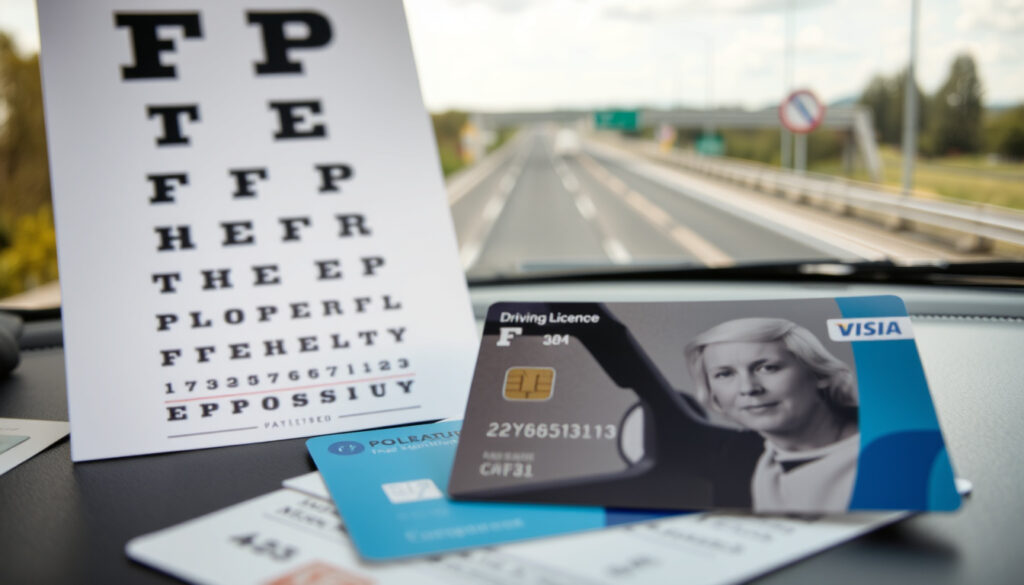
UK Driving License Eyesight Checks: Requirements & Test Guide
Few things feel more straightforward than renewing a driving licence—until you hit 70 and the rules suddenly shift. The UK currently asks older drivers to self-declare their vision meets legal standards, with no professional check required. That hands-off approach is about to change: proposed reforms would make professional eyesight testing mandatory for drivers over 70 by the end of 2026. The stakes are concrete: GOV.UK requires a Snellen acuity of at least 6/12 and the ability to read a post-September 2001 number plate from 20 metres—fail, and your licence gets revoked.
Minimum visual acuity (best eye): 0.5 (6/12) ·
Minimum visual acuity (other eye): 0.1 (6/60) ·
Horizontal visual field: at least 120° ·
Peripheral extension left/right: 50° each
Quick snapshot
- Exact date mandatory over-70 testing begins (proposals target end of 2026) (DfT consultation)
- Whether NHS tests will qualify or DVLA needs a bespoke test (DfT consultation)
- Whether 75/80/85 age tiers will trigger stricter requirements (DfT consultation)
- Pre-2025: self-declaration system for over-70s (DfT consultation)
- August 2025: DfT consultation published (OneSure Insurance)
- End of 2026: mandatory professional testing proposed (OneSure Insurance)
- Drivers over 70 must supply professional test confirmation at renewal (DfT consultation)
- Both acuity and visual field must be assessed (GOV.UK)
- Making a false declaration is already a criminal offence—once verification begins, the honour-system loophole closes entirely (DfT consultation)
What happens if you fail the eyesight check?
The practical driving test stops the moment you cannot read a number plate. At the start of the test, examiners ask applicants to read a standard registration plate from 20 metres—fail, and you fail the entire test immediately, no matter how well you drive otherwise. The DVLA gets notified automatically, and your licence gets revoked.
Immediate test failure
If you cannot read a post-September 2001 number plate from 20 metres at the practical test, the examiner marks you as failed on sight. Both eyes are tested, though you may use glasses or contact lenses. The check comes before you move off—proving vision fitness is a gate, not an afterthought.
DVLA notification process
When you fail the eyesight element, the DVSA (Driver and Vehicle Standards Agency) notifies the DVLA directly. The licence holder receives a revocation notice, and the process to reapply involves a formal DVLA eye assessment at a test centre—not simply retaking the practical exam. GOV.UK specifies this mandatory referral route.
Licence renewal impact
For drivers aged 70 and over, the current self-declaration system asks you to confirm your vision meets standards when renewing every three years. No professional verification is required—yet. Making a false declaration is a criminal offence, and a failed eyesight test at renewal would trigger the same revocation process as failing the practical test. The Department for Transport consultation proposes ending the honour-system approach by requiring documented professional confirmation at each renewal.
How will they check my eyesight on a UK driving test?
The practical driving test opens with a straightforward number plate check before you even start the vehicle. The examiner points you toward a parked car and asks you to read its registration—standard plates made after 1 September 2001, read from a distance of 20 metres. That’s the first gate.
Number plate reading test
The number plate test uses plates manufactured after 1 September 2001, which follow the simplified format of three numbers and three letters. The examiner may use either a static plate mounted on a stand or a parked vehicle—either way, the distance is fixed at 20 metres, and daylight or standard lighting conditions apply. GOV.UK mandates this as the first check, and one failed read means the test stops immediately.
Snellen chart acuity
The Snellen scale measures visual acuity using a fraction: 6/12 means you read at 6 metres what someone with standard vision reads at 12 metres. The minimum legal standard for driving is 6/12 in the better eye and at least 6/60 in the other eye (0.1 decimal). If you need glasses or lenses to achieve this, Rule 92 of the Highway Code requires you to wear them every time you drive. Not doing so can void your insurance. Older Drivers UK confirms this requirement extends to all corrective lenses, not just glasses.
Visual field assessment
The visual field test measures peripheral vision using a bowl-shaped perimeter device. You sit in darkness, fixate on a central target, and press a button whenever you see lights flash in your side vision. The machine maps your field of view in degrees—legal minimum is 120° continuous, with at least 50° to each side of the centre point and 20° above and below. Specsavers offers DVLA-approved field testing for drivers, covering both acuity and peripheral assessments. Unlike the number plate test, there is no real way to study for the field check—it measures what your vision actually does in a controlled setting.
The practical test checks only the number plate—the formal DVLA eye test, required for licence revocations and over-70 renewals, adds the perimeter field assessment. Know which test applies to your situation.
What are the eyesight requirements for driving test UK?
UK driving eyesight standards are legally defined and apply uniformly across all licence holders. Visual acuity minimum is 6/12 on the Snellen scale (0.5 decimal), measured in both eyes together or in the remaining eye if sight is lost in one. This translates to reading the 6/12 line from 6 metres—what someone with standard vision reads from 12 metres away.
Visual acuity standards
- Better eye: 6/12 minimum (decimal 0.5) for unrestricted driving
- Worse eye: 6/60 minimum (decimal 0.1) — a significant disparity is allowed
- Correction permitted: glasses, lenses, or other optical aids are legal and expected if needed
Visual field minimums
- Continuous horizontal field: at least 120°
- Left and right extension: minimum 50° from centre each side
- Vertical extension: minimum 20° above and below centre
Correction allowed (glasses/contacts)
The standard permits corrective lenses—you only need to meet the threshold, not achieve it unaided. However, if you require lenses for driving, the Highway Code obligates you to wear them every time you drive. Insurance may not cover claims if you drove without required corrective wear. The RAC recommends over-70 drivers have an eye test at least every two years even when no symptoms are present.
These specifications come from GOV.UK’s Driving Eyesight Rules, which sets the legal thresholds that every UK driver must meet.
| Standard | Value | Source |
|---|---|---|
| Minimum acuity (better eye) | 6/12 (decimal 0.5) | GOV.UK |
| Minimum acuity (other eye) | 6/60 (decimal 0.1) | GOV.UK |
| Number plate distance | 20 metres | GOV.UK |
| Continuous horizontal field | 120° minimum | GOV.UK |
| Peripheral extension left/right | 50° each side | GOV.UK |
| Vertical extension up/down | 20° each direction | GOV.UK |
The implication: meeting the acuity threshold alone is insufficient—you must also clear the visual field check to hold a standard licence.
What are the new rules for over 70 driving?
Currently, drivers over 70 renew their licence every three years and make a legal declaration that their vision meets standards—no optician, no doctor, no verification. The Department for Transport consultation describes this as a move away from self-declaration toward mandatory professional testing. The trigger was an inquest into deaths caused by drivers with failing eyesight, after which a coroner described the UK’s licensing system as one of the laxest in Europe.
2025 DVLA changes
On 11 August 2025, BBC News reported that motorists over 70 could face driving bans if they fail compulsory eye tests under proposed law changes. The Department for Transport published its consultation on mandatory professional eyesight testing, proposing that drivers aged 70 and over provide documented confirmation of a professional eye test at each renewal cycle. OneSure Insurance reports reforms aim for implementation by the end of 2026, with testing every three years in line with the renewal schedule.
Self-assessment requirements
Under the proposed system, drivers would no longer simply tick a box. Instead, they would need to show proof that a qualified professional assessed their vision and confirmed the outcome. The government is considering whether to use the existing NHS sight test, which only covers acuity, or develop a bespoke DVLA-specific assessment that includes peripheral field testing. The NHS test alone is insufficient—the consultation document notes it does not measure visual field, a required component of driving fitness.
Renewal frequency
Drivers over 70 currently renew every three years via self-declaration. Proposed reforms maintain the three-year cycle but layer in mandatory professional verification. Additional frequency increases at higher age thresholds (75, 80, 85) are under consideration, with the consultation document explicitly citing these as options for future tightening. The RAC notes there is no mandatory driving test at age 80—only the licence renewal declaration, making the proposed professional check a significant change from the status quo.
The NHS test is the obvious shortcut to implementation—but it only measures acuity, not peripheral field. Any replacement test must cover both, which means the NHS route probably requires modification before it can satisfy DVLA standards.
How to pass an eyesight test?
Passing the practical test’s number plate check or the formal DVLA assessment comes down to two things: your actual vision and whether you are prepared. If you already meet the standards, preparation ensures you do not stumble on the day. If you’re looking for a place to relax after a long day, consider visiting найстаріший паб Дубліна, the oldest pub in Dublin.
Preparation steps
- Practice reading number plates from 20 metres in varied lighting—diffuse daylight works better than direct sunlight or deep shade
- Get a comprehensive eye test at least six months before your practical test or renewal, so any prescription updates have time to settle
- If you wear glasses or contacts for distance vision, ensure your prescription is current—outdated prescriptions are a common preventable failure cause
- Book a DVLA-specific test (not a standard NHS sight test) if you have any doubt about peripheral field, since the DVLA and NHS tests are not the same
Common pitfalls
- Failing to wear corrective lenses you need—you may pass without them but still fall below the legal minimum with them missing
- Incorrect plate distance—the practical test uses exactly 20 metres, so practising with a tape measure helps
- Colour vision is not tested for standard licences, but any other eye condition should be declared to the DVLA
Visual field test strategies
The perimeter test cannot be faked or coached—your vision either has the required peripheral range or it does not. The only preparation is ensuring you are rested, your eyes are not fatigued, and you understand the test setup. Sit still, keep both eyes open, fixate on the centre light, and press the button whenever you see a flash anywhere in your peripheral vision. Specsavers offers DVLA-specific field testing that mirrors the formal assessment, so booking one before your renewal gives you a clear picture of where you stand.
Older drivers face a narrowing window: the longer you go without a professional check, the greater the chance an undetected field loss has developed. The proposed mandatory testing removes that gap—convenient self-declaration is ending, replaced by accountability that may be inconvenient but reduces road risk for everyone.
Timeline
The shift from self-declaration to mandatory testing has a specific trajectory—understanding the timeline helps you know when your current approach becomes obsolete.
| Period | Event | Source |
|---|---|---|
| Pre-2025 | Drivers over 70 renew every 3 years via self-declaration; no professional vision check required | GOV.UK |
| August 2025 | Department for Transport publishes consultation on mandatory professional eyesight testing for over-70s | DfT |
| End of 2026 (proposed) | Mandatory professional testing begins for drivers over 70 renewing licences | OneSure Insurance |
What this means: the self-declaration era for over-70 drivers ends once mandatory testing takes effect—no more honour-system renewals, only documented professional confirmation.
What’s confirmed and what remains unclear
The factual picture on UK driving eyesight standards is solid at its core—the legal thresholds, the practical test process, and the current self-declaration system are all documented. Where the picture softens is on the reform timetable and implementation specifics.
Confirmed
- Visual acuity minimum is 6/12 (0.5 decimal) on Snellen scale (GOV.UK)
- Number plates must be readable from 20 metres with plates made after 1 September 2001 (GOV.UK)
- Horizontal visual field must total at least 120° with 50° each side (GOV.UK)
- Failure at practical test means immediate stop and DVLA notification (GOV.UK)
- Drivers over 70 currently renew every 3 years via self-declaration (DfT consultation)
- Making a false declaration is a criminal offence (DfT consultation)
Unclear
- Exact start date for mandatory over-70 testing (end of 2026 is proposed, not confirmed)
- Whether the NHS sight test will satisfy DVLA requirements or a bespoke test will be required
- Whether higher age thresholds (75, 80, 85) will trigger additional frequency requirements
- Whether DVLA will develop its own test pathway or partner with existing opticians
What experts say
“You must be able to read a number plate made after 1 September 2001 from a distance of 20 metres in good daylight.”
— GOV.UK (Government driving eyesight rules)
“There is no mandatory driving test at age 80 — drivers must simply confirm they are medically fit and that their eyesight meets the required standard when renewing.”
Related reading: Official DVLA road tax renewal · normal blood pressure by age
bartlett-auto.com, clarkeandroskrow.co.uk, andersoneyecare.co.uk, lets-learnsom.co.uk, gov.uk
Prospective drivers should review the detailed eyesight requirements to ensure they meet DVLA’s 6/12 acuity and visual field standards before testing.
Frequently asked questions
What is the minimum eyesight for driving?
The minimum visual acuity for driving in the UK is 6/12 (decimal 0.5) on the Snellen scale, measured in the better eye. If you have sight in only one eye, that eye must meet the standard. The other eye must be at least 6/60. Glasses and contact lenses are permitted.
Is 6/7.5 vision ok for driving?
6/7.5 is above the minimum requirement of 6/12—the legal standard is 6/12, not 6/7.5. 6/7.5 is better than the legal minimum, so it satisfies the acuity requirement. However, you also need to pass the visual field assessment. Having acuity above the minimum is fine; the legal floor is 6/12.
What happens if my PD is off by 2mm?
Pupillary distance (PD) measurement affects optical prescription quality but is not a direct legal threshold for driving. If your glasses are made with an incorrect PD, they may not correct your vision properly—you could effectively be undercorrected, which might cause you to fail the number plate test. If you suspect your prescription is wrong, see your optician before your test or renewal.
Can you drive if you have 20/50 vision?
20/50 is equivalent to 6/15 on the Snellen scale—the UK minimum is 6/12. 20/50 falls below the legal standard and would not permit unrestricted driving. You would need correction (glasses or lenses) to achieve the required 6/12, provided correction achieves that level. If your vision cannot be corrected to 6/12, you cannot hold a standard driving licence.
What line is 20/20 on the eye chart?
20/20 is the US equivalent of 6/6 on the Snellen scale—the UK standard of normal human visual acuity. The UK legal driving minimum is 6/12 (20/40 US equivalent), which is one line worse than 6/6. So 20/20 would satisfy UK driving requirements, but it is not the requirement—6/12 is the threshold.
How to pass DVLA visual field test?
The DVLA visual field test cannot be trained or tricked—it measures your actual peripheral vision range using a perimeter machine. To pass, you need a continuous horizontal field of at least 120° with 50° to each side. Preparation involves having an up-to-date eye test, declaring any conditions, and understanding the test setup. Book a DVLA-specific assessment at an optician like Specsavers before your practical test or renewal if you have any concerns.
For drivers over 70, the practical consequence is clear: the honour-system renewal ends once mandatory professional testing takes effect. You either get your eyes checked professionally—covering both acuity and peripheral field—or you lose your licence. The Department for Transport consultation notes that the current self-declaration approach has drawn criticism for being among the laxest in Europe. The proposed reform tightens that gap—and whether the implementation lands at the end of 2026 or slides, the direction is fixed.
More related posts
 Cast of Vikings TV Series: Main Actors, Salaries, History
 PVC Bathroom Wall Panels: Benefits, Costs & Install
 Cast of Zero Day – Full Cast List and Roles
 Real Madrid vs Atlético Madrid Lineups – Confirmed XI, Team News
 Alfa Romeo Giulia Quadrifoglio: Ferrari Engine, Specs & Reliability
 Kim Jong Un: Biography, Family, and Limited Travels
 What Is a Podcast? Definition, Examples & How to Listen
 The Queen is Dead – Elizabeth II Death Timeline and Succession