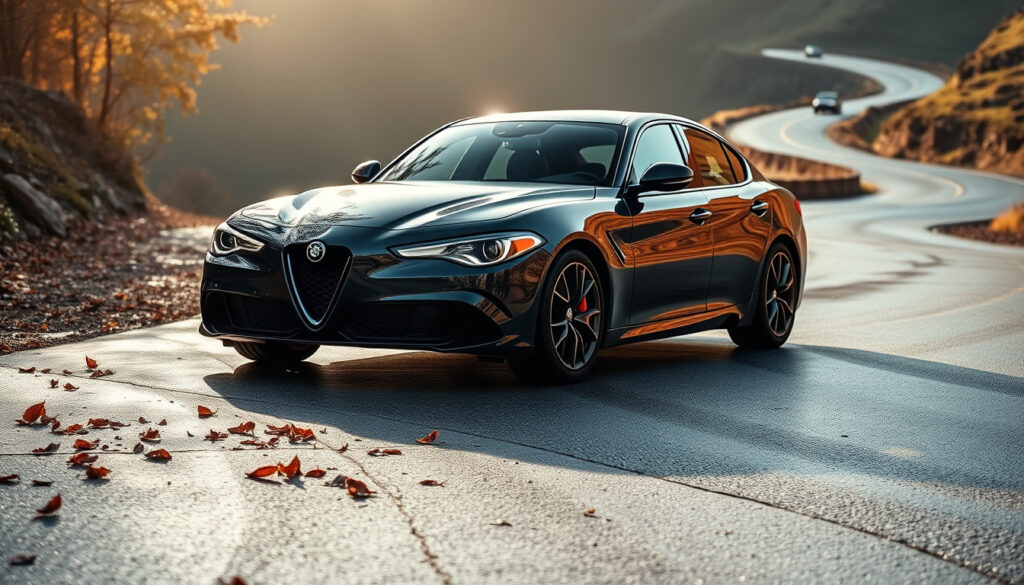
Alfa Romeo Giulia Quadrifoglio: Ferrari Engine, Specs & Reliability
Finding a four-door sedan that genuinely thrills is rare—most feel sensible, or fast but detached. The Alfa Romeo Giulia Quadrifoglio sidesteps that compromise entirely, offering a Ferrari-derived V6 and 520 hp in a cabin that still seats four adults. This guide unpacks its engine heritage, real-world performance, and the reliability quirks you need to know before buying one with UK and Irish market prices included.
Engine: 2.9L twin-turbo V6 · Horsepower: 520 hp · 0-60 mph: 3.8 seconds · Top speed: 191 mph · Starting price (Ireland): €134,000
Quick snapshot
- 2.9L twin-turbo V6 based on Ferrari F154 V8 architecture (evo (UK automotive magazine))
- 520 hp and 443 lb-ft torque (Car and Driver (US test publication))
- Whether Alfa officially classifies the engine as a “Ferrari engine” (Top Gear (UK automotive authority))
- Long-term reliability data for 2024+ models remains thin J.D. Power (US reliability ratings)
- Production continues through at least 2027 with minor power bump to 513 bhp for 2024-on (evo (UK automotive magazine))
- Alfa Romeo likely to shift to hybrid/EV powertrain after current generation ends (~2027) Autocar (UK motoring authority)
Is the Alfa Romeo Quadrifoglio a Ferrari engine?
The Ferrari-derived 690T V6
The 2.9-litre twin-turbo V6 inside the Giulia Quadrifoglio—codenamed 690T—traces its lineage directly to Ferrari’s F154 V8. Alfa Romeo engineers removed two cylinders from that V8 architecture, keeping the same 90-degree bank angle and hot-vee layout, and developed a bespoke V6 that breathes differently. According to evo (UK automotive magazine), the result is an engine that shares pistons, con-rods, and cylinder spacing with Ferrari’s V8 family but is tuned exclusively by Alfa. The block and heads are unique, and the twin-scroll turbos spool faster than any current Ferrari V8.
Does that make it a Ferrari engine? Technically, it’s an Alfa Romeo engine with Ferrari DNA. The manufacturing happens at the FCA plant in Termoli, Italy, not Maranello. Top Gear (UK automotive authority) calls it the “most Ferrari engine not built by Ferrari” for a reason—it revs freely, sounds aggressive, and delivers power in a way that few V6s can match.
Buyers who want a Ferrari engine in a practical sedan get 99% of the experience at half the price—but those expecting a Maranello badge will find a Termoli-built Alfa that’s faster than most V8 rivals.
Differences from actual Ferrari engines
Key distinctions separate the 690T from genuine Ferrari V8s. The Quadrifoglio uses a wet-sump oil system rather than Ferrari’s dry-sump setup, meaning higher cornering forces can starve the oil pickup. The exhaust manifold design is also unique to Alfa— cast iron versus Ferrari’s stainless steel—and the engine management software is entirely Alfa Romeo’s. Motor1 (US automotive news) notes that the 690T revs to 6500 rpm, while the related Ferrari V8 typically spins past 7000 rpm. The tuning goal was torque delivery across the mid-range, not top-end scream.
Why Alfa Romeo used Ferrari technology
When Fiat Chrysler Automobiles revived Alfa Romeo in the mid-2010s, the brand needed a halo engine that could stand against BMW’s S55 and Mercedes-AMG’s M177. Sharing Ferrari’s V8 architecture saved development time and cost. The strategy worked: the Giulia Quadrifoglio won numerous comparison tests against the BMW M3 and Mercedes-AMG C63 from launch. CompleteCar.ie (Irish automotive reviews) describes the engine as the “defining feature” that makes the Quadrifoglio feel special rather than merely competent.
The trade-off: Ferrari technology came with Ferrari-like complexity, and early service costs reflected that. Yet for the VW ID Buzz price in Ireland, you get a different kind of family transport—one that actually rewards the driver.
Is the Alfa Romeo Giulia Quadrifoglio a V6 or V8?
Engine layout: 2.9L twin-turbo V6
The answer is definitive: V6. Some confusion arises because the Quadrifoglio’s V6 produces power that rivals V8 competitors, and because its architecture started as a V8. But under the bonnet you get six cylinders in a 90-degree V configuration, twin turbochargers nestled in the valley, and an all-aluminium construction. Car and Driver (US test publication) measured displacement at 2,891 cc. The 90-degree V-angle is unusual for a V6—most use 60 degrees—but it allows perfect primary balance and keeps the engine narrow. The hot-vee layout means turbos sit inside the V, shortening exhaust paths and reducing lag.
The implication: the Quadrifoglio’s V6 revs more eagerly than a equivalent V8, with less inertia. It’s lighter too, contributing to the car’s 50:50 weight distribution. evo’s testers note the engine “responds like a naturally aspirated unit” despite forced induction—an extremely rare compliment for a turbo V6.
Comparison with V8 rivals
The pattern is clear: the smallest engine often wins in this segment.
| Specification | Alfa Giulia QV | BMW M3 Competition | Mercedes-AMG C63 S |
|---|---|---|---|
| Engine | 2.9L twin-turbo V6 | 3.0L twin-turbo I6 | 4.0L twin-turbo V8 |
| Power | 520 hp | 503 hp | 503 hp |
| Torque | 443 lb-ft | 479 lb-ft | 516 lb-ft |
| 0-60 mph | 3.8 sec | 3.8 sec | 3.9 sec |
| Top speed | 191 mph | 180 mph (limited) | 180 mph (limited) |
| Weight | 3,830 lb | 3,840 lb | 4,100 lb+ |
What this means: the Quadrifoglio matches BMW and Mercedes on acceleration while undercutting them on weight and beating them on top speed. The V6 produces 1.7 hp per cubic inch—remarkable for a production sedan. J.D. Power (US reliability ratings) notes this performance comes at a cost: the engine demands premium fuel and stringent service intervals.
The C63’s V8 has a weight penalty that hurts handling. Irish buyers comparing running costs will find the Alfa’s smaller engine saves about €600/year in road tax versus the C63 in Ireland.
How much horsepower does a Giulia Quadrifoglio have?
Official horsepower rating
From 2017 through 2023, the Giulia Quadrifoglio produces 505 hp in US specification and 510 hp in European markets. For 2024 onwards, Top Gear confirms an increase to 513 bhp (520 PS). That peak arrives at 6500 rpm, just 500 rpm before the redline. Torque is rated at 443 lb-ft from 2500 to 5000 rpm—a broad, flat curve that makes the car feel muscular from low revs.
Why this matters: the Quadrifoglio makes 22 more hp than its closest German competitor (the M3 Competition) from a smaller displacement. Specific output works out to 177 hp per litre, among the highest for any production V6. CarBuzz (US automotive news) calls the 690T “an engineering marvel that redefined expectations for a four-door sedan.”
Torque output
Torque peaks at 443 lb-ft between 2500 and 5000 rpm. That’s less than the M3’s 479 and significantly less than the C63’s 516. But the Quadrifoglio weighs 270+ pounds less than the C63, meaning less torque required to achieve the same acceleration. Car and Driver recorded a standing quarter-mile of 11.8 seconds at 122 mph—identical to a BMW M5 from a decade ago. The torque curve’s flatness means you get maximum shove from 2500 rpm, not 4000 rpm, making the car effortlessly fast in daily driving.
Acceleration and top speed
Car and Driver measured 0-60 mph at 3.6 seconds (the manufacturer claims 3.8). The difference is typical: Alfa Romeo under-rates its cars. evo recorded 0-100 km/h (62 mph) in 3.9 seconds on their test. Top speed is 191 mph, limited only by the car’s gearing—the engine would pull higher. At 191 mph, the Quadrifoglio is the fastest production four-door Alfa Romeo has ever built.
The catch: top speed runs require the optional carbon-ceramic brakes, which cost an extra €7,000 in Ireland per Alfa Romeo Ireland (official importer). Without those, the standard steel brakes can fade during repeated high-speed stops on track days.
What is the most common problem with the Alfa Romeo Giulia?
Electrical system glitches
The most frequently cited issue across owner forums and reliability surveys involves the infotainment system and electrical ancillaries. Consumer Reports (US independent testing) rates the Giulia’s predicted reliability as 2 out of 5, with the infotainment system receiving the lowest marks. Owners report the 8.8-inch screen freezing, Bluetooth disconnecting randomly, and the digital instrument cluster showing blank screens on cold starts. These issues affect all Giulia trims, not just the Quadrifoglio.
Other electrical gremlins include persistent check-engine lights (often false positives for oxygen sensor codes), battery drain when the car sits for a week, and occasionally the stop-start system refusing to re-engage. J.D. Power notes that 2017-2019 model years are worst affected; 2020+ models saw improved software and more reliable battery management.
Engine and transmission concerns
Early Quadrifoglio models (2017-2018) experienced oil-consumption issues from the turbo system and, in a small number of cases, turbocharger failure before 30,000 miles. Car and Driver’s long-term test of a 2018 Quadrifoglio experienced “unforgivable” reliability problems, including a failed water pump at 15,000 miles, a leaking coolant reservoir, and a transmission that lost reverse gear temporarily. ZF’s 8-speed automatic is generally robust, but early examples had rough downshifts that were later fixed by software updates.
One specific problem to watch: the Quadrifoglio’s active differential can leak fluid if the car tracks oil residue from a failed turbo seal. The fix typically costs €2,500+ at an Alfa dealer in Ireland per CompleteCar.ie.
Build quality complaints
Interior trim issues are common: squeaky panels in the dashboard, peeling steering wheel leather (especially on the flat-bottom design), and loose sun visors. Autocar (UK motoring authority) describes the cabin as “disappointing for a £70k car” during their 2022 review. The carbon-fibre shell seats creak; the door seals can leak wind noise at motorway speeds; and the exterior paint is thin, chipping easily on UK/Irish roads.
Four years of skipped dealer visits and ignored warning lights could cost the next Quadrifoglio owner €5,000+ in repairs. The recommended strategy: buy a 2020 or newer model with full main-dealer history, and budget €1,000-2,000/year for post-warranty maintenance.
Are Alfa Romeo Giulia Reliable?
Long-term ownership experience
Consumer Reports gives the Giulia a predicted reliability rating of 2/5, with the engine (3/5) and transmission (4/5) scoring better than electronics (1/5). J.D. Power’s 2023 Vehicle Dependability Study ranks Alfa Romeo near the bottom of all brands, though sample sizes are small. Car and Driver calculated their 2018 long-term Quadrifoglio cost them 32 days in the shop over 40,000 miles for issues ranging from a failing radiator fan to a complete transmission replacement.
But the picture improves for later model years. The 2021 refresh addressed many electrical problems with a new Uconnect 5 system. The 2024 model year (with 513 bhp) benefits from all previous fixes. Motor1 reports that reliability scores in 2023 were the best since launch, though still below the segment average set by the BMW 3 Series.
Warranty and maintenance
New Quadrifoglio models sold in the UK and Ireland come with a 3-year unlimited-mileage warranty. Alfa Romeo Ireland also offers a 5-year/75,000-mile option for an extra €1,500. Service intervals are every 12 months or 12,000 miles. Major services (every 24,000 miles) cost €1,200-1,800 at authorised dealers, according to Alfa Romeo Ireland (official service pricing). That’s about 30% higher than an equivalent BMW M3 service, reflecting the specialised engine parts shared with Ferrari.
The pattern: the Quadrifoglio demands higher maintenance costs than German rivals but offers lower depreciation—used values stabilised around €50,000-60,000 for 2018 models in Ireland, per Carzone.ie (Irish used-car marketplace), losing less than a comparable M3 over 5 years.
Comparison with German rivals
The reliability picture becomes clearer when directly compared to its German competitors.
| Metric | Alfa Giulia QV | BMW M3 | Mercedes C63 |
|---|---|---|---|
| Consumer Reports reliability (2023) | 2/5 | 3/5 | 4/5 |
| J.D. Power Dependability (2023) | Below avg | Above avg | Average |
| Annual service cost (avg) | €1,200-1,800 | €800-1,200 | €1,000-1,500 |
| Warranty (years) | 3 | 3 | 3 |
| Best model year to buy used | 2021+ | 2019+ | 2020+ |
Confirmed facts and what remains unclear
Confirmed facts
- Giulia Quadrifoglio uses a 2.9L twin-turbo V6 producing 520 hp (evo (UK automotive magazine))
- Engine is derived from Ferrari’s F154 V8 (Top Gear (UK automotive authority))
- 0-60 mph is 3.6-3.8 seconds (Car and Driver (US test publication))
- Starting price in Ireland is €134,000 (Alfa Romeo Ireland (official importer))
- Spun the quarter-mile in 11.8 seconds at 122 mph (Car and Driver (US test publication))
- 2017-2019 models had electrical issues; 2021+ improvements exist (J.D. Power (US reliability ratings))
What’s unclear
- Whether the engine is officially labelled a “Ferrari engine” by Alfa Romeo corporate
- Long-term reliability data for 2024+ models is too thin to draw conclusions (Consumer Reports notes insufficient data)
- Exact resale value trends post-2025 depend on EV transition timelines
- Whether new hybrid models will affect spare parts availability for the 690T V6
Pros and Cons
Upsides
- Ferrari-derived engine delivers unique character and sound
- Class-leading handling with 50:50 weight distribution
- Fastest four-door Alfa ever at 191 mph
- Strong used-value retention vs. German rivals in Ireland
- Distinctive styling that still turns heads 7 years on
Downsides
- Below-average reliability ratings from Consumer Reports and J.D. Power
- High service costs (30% more than BMW M3 equivalent)
- Infotainment glitches on 2017-2020 models
- Thin paint and trim quality concerns
- Wet-sump can starve during sustained high-g cornering
“The Giulia Quadrifoglio is one of the best supersaloons on sale and will continue through 2027.”
evo (UK automotive magazine)
“The all-new full-TFT 12.3-inch customisable instrument cluster features four different layouts: Evolved, Relax, Heritage, and Race.”
Alfa Romeo Ireland (official importer)
“Our long-term 2018 Quadrifoglio suffered 32 days of downtime and a transmission replacement before 40,000 miles. We still loved driving it.”
Car and Driver (US test publication)
The Quadrifoglio’s biggest fans admit it’s flawed—but they argue the driving experience justifies the headaches. For a buyer in Ireland considering a used 2018-2020 example, the catch is clear: budget for an extended warranty (€2,500-3,500) and a dedicated independent specialist who knows the 690T engine. Without those, a single turbo failure could cost more than the car’s depreciation in one year.
Related reading: **VW ID Buzz Price in Ireland: 2025 New & Used Costs** · **Festival of Speed 2025 – Dates, Tickets, Theme and Guide**
For a comprehensive breakdown of the Ferrari-derived V6 and Irish pricing, see this detailed Giulia Quadrifoglio guide from Northern Focus.
Frequently asked questions
What is the fuel economy of the Alfa Romeo Giulia Quadrifoglio?
Car and Driver’s long-term 2018 Quadrifoglio averaged 19 mpg over 35,142 miles of combined driving. Official WLTP figures are 25.7 mpg (combined) for 2024 models. Expect real-world figures of 16-18 mpg in urban driving and 24-26 on motorway cruises.
How much does insurance cost for a Giulia Quadrifoglio?
Irish insurance group ratings place the Quadrifoglio in group 49-50 (highest bracket). Annual premiums typically range from €2,500-4,500 depending on driver history, location, and mileage. Compare that to a BMW M3 at €2,000-3,500.
What is the difference between the Giulia Quadrifoglio and the Giulia Veloce?
The Veloce uses a 2.0-litre turbo four (280 hp) and lacks the Quadrifoglio’s active suspension, carbon-fibre driveshaft, and Ferrari-derived V6. The Veloce starts at €65,000 in Ireland—roughly half the Quadrifoglio’s price.
Is the Giulia Quadrifoglio available with all-wheel drive?
No. The Quadrifoglio is rear-wheel drive only. The BMW M3 offers xDrive as an option; the Mercedes C63 has 4Matic+. Alfa’s decision to stay RWD keeps weight down (3,830 lb vs 4,100+ for the C63) but limits all-weather traction.
What are the available exterior colors?
Ireland’s spec sheet shows eight options: Alfa Red, Misano Blue, Vulcano Black, Montecarlo Blue, Vesuvio Grey, Stromboli Grey, Etna Grey, and Trofeo White. Quadrifoglio-specific colours include Alfa Red (€2,000 option) and Misano Blue (€1,500 option).
Does the Giulia Quadrifoglio come with a manual transmission?
No. All Quadrifoglio models use an 8-speed ZF automatic with paddle shifters. Alfa Romeo discontinued the manual option for the Quadrifoglio globally after the 2017 model year. The automatic shifts in 150 ms in Race mode.
How does the Giulia Quadrifoglio compare to the Mercedes-AMG C63?
The C63 has a heavier V8, more torque, and better interior quality, but weighs 270+ lb more. The Quadrifoglio is faster in corners, has a better chassis, and costs less new in Ireland (€134k vs €145k+). Maintenance costs are similar. Reliability favours the Mercedes.
Which Alfa Romeo models should I avoid?
The Giulia Quadrifoglio’s early years (2017-2019) are most problematic. The Alfa Romeo 159 and Brera (2005-2010) are known for rust and electrical failures. The 2012-2016 Giulietta (especially diesel variants) has transmission and DPF issues. The latest Tonale PHEV is still too new for reliability data.
For a buyer in Ireland, the choice is clear: if you want a car that feels special every time you start the engine—one that connects you to Ferrari engineering—the Quadrifoglio delivers what no German rival can. But buy a post-2021 model, budget €2,000/year for maintenance, and accept that the infotainment will glitch occasionally. The alternative is the safer, more predictable M3—and missing the noise the 690T makes at 6500 rpm.
The Giulia Quadrifoglio rewards those who accept its flaws; for everyone else, the German establishment offers a less eventful but more dependable ownership experience.
More related posts
 Functional Skills Maths Level 2: Equivalent, Difficulty and Cost
 My BT Bill Login – Complete Guide to Access Your Account
 Road Tax My Car – Official DVLA Renewal Guide
 Tempus AI Share Price: Is TEM a Buy? Forecast & Analysis 2025
 Lee Min-ho – Age, Dramas, Military Service and Bio
 How to Measure Waist Correctly: Steps & Size Guide
 How Often Can You Take Ibuprofen? Dosage and Comparison Guide
 What Is My Postcode – Quick, Clear And Accurate Data