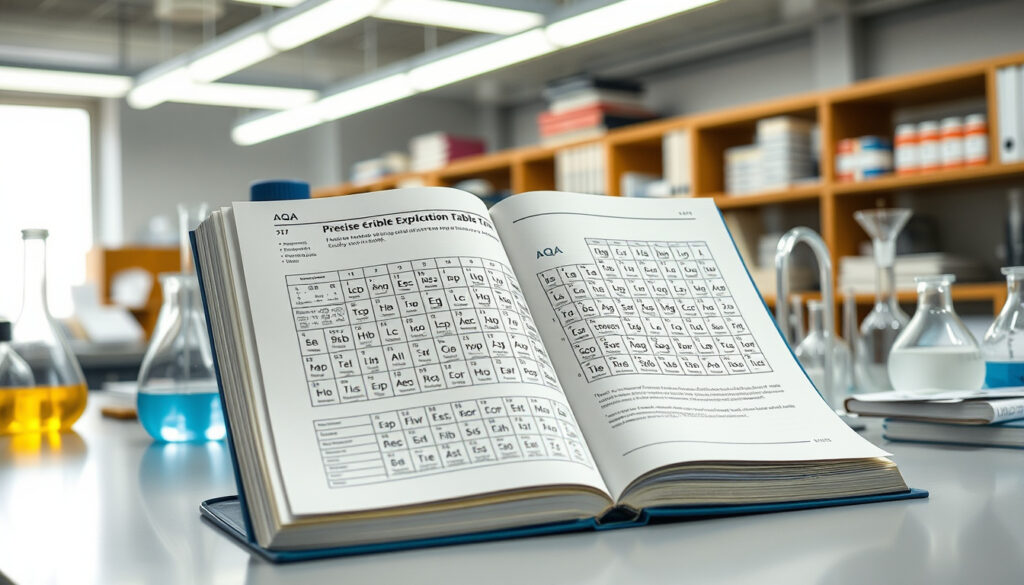
Periodic Table AQA A Level – Data Booklet Contents Guide
The AQA A-Level Chemistry Data Booklet serves as an essential reference material provided alongside examination papers for specification 7405. This resource eliminates the need for students to memorise extensive spectroscopic data and physical constants, allowing them to focus on applying their understanding during Paper 1 and Paper 2 assessments. Understanding what this booklet contains—and how it differs from earlier specifications or alternative exam boards—can significantly improve revision efficiency and examination confidence.
The data booklet includes a complete periodic table showing all elements from hydrogen through the actinides, along with specialised tables for infrared absorption data, proton nuclear magnetic resonance chemical shifts, and carbon-13 nuclear magnetic resonance chemical shifts. Students also receive structures of biologically relevant molecules such as phosphates, sugars, nucleobases, amino acids, and the heme group. These resources are particularly valuable for organic synthesis and spectral interpretation questions that appear throughout the linear assessment.
What is Included in the AQA A-Level Chemistry Data Booklet?
The AQA A-Level Chemistry Data Booklet functions as an official examination insert, distributed with live papers for specification 7405. Its primary purpose is to provide students with reference data that would otherwise require memorisation, allowing assessment to focus on application and analysis rather than recall.
The data booklet is provided as a physical insert with your examination papers. You do not need to bring your own copy—each candidate receives one automatically when sitting Paper 1 or Paper 2.
Periodic Table Contents
The periodic table section displays all 118 elements in standard format, showing atomic (proton) number, element symbol, element name, and relative atomic mass values. The layout includes entries such as hydrogen (H, 1.0), helium (He, 4.0), sodium (Na, 23.0), and chlorine (Cl, 35.5). Footnotes identify the lanthanides (elements 58–71) and actinides (elements 90–103) separately, reflecting their positioning in the full periodic table structure.
Unlike some revision resources, the AQA booklet presents relative atomic masses rounded to appropriate significant figures for examination calculations. Students should note that these values differ slightly from those used at GCSE level, where simpler whole-number approximations may have been acceptable. Those seeking additional context on how the periodic table is organised may find detailed periodic table explanations helpful for building foundational understanding.
Infrared Spectroscopy Data
Table A provides infrared absorption data with wavenumber ranges measured in cm⁻¹. This information enables students to identify functional groups within molecules by matching observed absorption peaks to documented bond stretching frequencies.
| Bond Type | Wavenumber Range (cm⁻¹) | Common Examples |
|---|---|---|
| O-H | 2500–3000 (acids), 3300–3500 (alcohols/amines) | Carboxylic acids, alcohols, amines |
| N-H | 3300–3500 | Primary and secondary amines |
| C≡N | 2220–2260 | Nitriles |
| C=O | 1680–1750 | Carbonyl compounds, aldehydes, ketones |
| C=C | 1620–1680 | Alkenes |
| C-O | 1000–1300 | Ethers, esters, alcohols |
The overlap between certain absorption ranges—such as O-H stretches in both carboxylic acids and alcohols—requires students to interpret additional contextual information from question wording and other spectral data.
Nuclear Magnetic Resonance Spectroscopy
The booklet provides two dedicated NMR tables. Table B covers ¹H NMR chemical shift data expressed in delta parts per million (δ/ppm), while Table C presents ¹³C NMR chemical shift ranges for different carbon environments.
These NMR tables are available only in the A-Level specification (7405). Students sitting AS-Level Paper 1 under specification 7404 will not have access to this spectroscopy data, making organic analysis questions less prevalent at that stage.
The ¹H NMR table includes proton types ranging from hydroxyl groups (ROH, 0.5–5.0 δ) through aromatic systems (Ar-H, 6.0–8.5 δ) to aldehydic protons (-CHO, 9.0–10.0 δ). The ¹³C NMR table similarly covers carbon environments from alkyne carbons (~80 δ) through carbonyl and carboxylic acid carbons (190–220 δ).
How Does the AQA A-Level Data Booklet Compare to GCSE and OCR Versions?
The AQA A-Level data booklet differs substantially from both its AS-Level counterpart and the resources provided by other examination boards. These differences have practical implications for students transferring between specifications or comparing revision materials.
A-Level Versus AS-Level (7405 vs 7404)
The A-Level specification includes the full data booklet with NMR tables and organic molecular structures. The AS-Level version, designated 7404, provides a simplified booklet covering the periodic table and infrared data only. This means A-Level candidates sitting Paper 2 receive additional spectroscopic reference material not available to AS candidates.
The Oxford AQA International version mirrors the standard A-Level content, including periodic table data and spectroscopy tables. Students following international specifications should verify their booklet matches these expectations.
A-Level Versus GCSE Resources
GCSE chemistry examinations do not provide a comparable data booklet insert. At GCSE level, the periodic table supplied is more basic, typically showing fewer data columns without the detailed atomic mass information required for stoichiometric calculations. Students progressing to A-Level should expect a significantly more comprehensive reference document.
Legacy AQA specifications such as 2420 offered data sheets, though these are now outdated and do not reflect current examination requirements. Current specification materials align with the 7405 framework introduced under the reformed A-Level structure.
AQA Versus OCR Comparison
OCR A-Level Chemistry provides its own data resources, which differ in presentation and content scope. While OCR includes similar periodic table and spectroscopy data, the exact layout and table formatting may vary. Students using past papers from alternative boards should familiarise themselves with both formats to avoid confusion during examinations.
Data booklets are specific to their examination board and specification. Do not assume data tables are identical between AQA and OCR, even for the same topic. Always verify values against the appropriate specification resource before revision.
How to Access the AQA A-Level Chemistry Data Booklet
While the data booklet is provided automatically during examinations, students benefit from reviewing specimen and past paper versions during revision. These materials are available through various educational repositories and tutoring platforms.
Physics and Maths Tutor hosts PDF copies of the AQA data sheet alongside past examination papers, allowing students to familiarise themselves with the exact format used in live assessments. The AQA Chemistry Data Sheet available through their platform provides a reliable reference matching official examination materials.
Save My Exams similarly offers a comprehensive overview of the data booklet contents, describing each table and explaining the information available within the insert. Their A-Level Chemistry Data Sheet resource provides context alongside the raw data.
The official AQA specification document outlines the assessment structure and confirms the data booklet provision. Students can access the specification at a glance to verify which papers include the data booklet insert.
What Information Remains Established Versus Uncertain?
The AQA A-Level specification establishes certain aspects of the data booklet provision definitively, while other details may vary depending on examination series and update cycles.
| Established Information | Aspects Requiring Verification |
|---|---|
| Data booklet provided for Paper 1 and Paper 2 (7405) | Exact formatting may be updated for future series |
| Includes periodic table, IR data, NMR tables | Specific footnote wording may change between editions |
| Values reflect specification requirements | Students should always verify against official AQA materials for current series |
| AS-Level version (7404) lacks NMR tables | International versions may have slight content variations |
AQA updates examination materials periodically, though fundamental data values such as chemical shift ranges and infrared absorption frequencies remain consistent with established chemical principles. Students should always cross-reference their revision materials against the most recent specimen booklets available through official channels.
Why the Data Booklet Matters for Examination Success
The AQA A-Level Chemistry Data Booklet removes the burden of memorising extensive reference data, allowing assessment to focus on higher-order skills. Questions requiring identification of organic compounds through spectral analysis depend on candidates correctly interpreting data from the booklet rather than recalling values from memory.
Common examination errors include misreading chemical shift ranges, confusing similar absorption values (such as O-H stretches in acids versus alcohols), and failing to check the correct table for the required information. Familiarity with the booklet layout during revision helps candidates navigate to the correct data quickly during timed assessments.
Students who have reviewed past paper data booklets alongside their revision notes develop confidence in locating specific information efficiently. This preparation proves particularly valuable for Paper 2 questions that combine organic synthesis with analytical techniques requiring spectroscopic data interpretation.
Sources and References
The content of the AQA A-Level Chemistry Data Booklet is defined by the official AQA Chemistry 7404/7405 specification. Educational repositories including Physics and Maths Tutor and Save My Exams provide accessible copies of these materials for revision purposes.
The AQA 7405 specimen data booklet available through A Level Chemistry represents one reliable reference source matching the materials provided in current examination series.
The data booklet for AQA A-Level Chemistry (7405) is provided as an insert with Papers 1 and 2. It includes a periodic table, infrared absorption data, ¹H and ¹³C NMR data, and structures of selected organic molecules.
— AQA Chemistry Specification 7404/7405
Summary
The AQA A-Level Chemistry Data Booklet for specification 7405 serves as an essential examination resource, providing the periodic table, infrared absorption data, and nuclear magnetic resonance chemical shift information. Unlike the AS-Level version, it includes comprehensive NMR tables and organic molecular structures. Students benefit from familiarising themselves with the booklet layout during revision, ensuring they can locate reference data efficiently during examinations. For further revision materials and examination practice, explore the Science-Backed Effects and Risks resources on related chemistry topics.
Frequently Asked Questions
Is the AQA A-Level data booklet the same as the AS-Level version?
No. The A-Level version (specification 7405) includes NMR tables and organic molecular structures, while the AS-Level version (specification 7404) lacks these sections.
Where can I download the AQA A-Level Chemistry data sheet PDF?
The data booklet is provided automatically during examinations. Specimen versions are available through educational platforms such as Physics and Maths Tutor and Save My Exams.
Do I need to memorise the data in the booklet?
No. The data booklet is provided as an examination insert. Students should focus on understanding how to apply the data rather than memorising values.
How is the AQA data booklet different from OCR A-Level materials?
While both boards provide similar reference data, the exact format, layout, and sometimes the values differ. Always use the specific board’s data booklet when practising past papers.
Does the data booklet change between examination series?
Fundamental chemical data remains consistent, though AQA may update formatting or provide updated specimen versions. Always verify against current official materials.
Can I use the data booklet for GCSE Chemistry?
No. GCSE examinations do not provide an equivalent data booklet insert. The A-Level booklet contains information beyond GCSE requirements and would not be appropriate for those assessments.
What papers include the data booklet?
For AQA A-Level Chemistry (7405), the data booklet is provided with Paper 1 and Paper 2. AS-Level candidates (7404) receive a more limited version with Paper 1 only.
More related posts
 Benefits of Apple Cider Vinegar – Science-Backed Effects and Risks
 Louis Saha: Net Worth, Career, Religion & Life Now
 EFL League One Players – Top Scorers and EA FC Ratings 2025/26
 What Month Is September – Calendar History And Culture
 PS5 Pro Release Date: Price, Specs & Is It Worth It in 2026
 Air Fryer Jacket Potato: Crispy & Fluffy in 45 Minutes
 Reset Apple ID Password: Official Steps for iPhone, Mac & Online
 Charlotte Jordan: New BBC Drama, The Archers Role, Corrie Exit