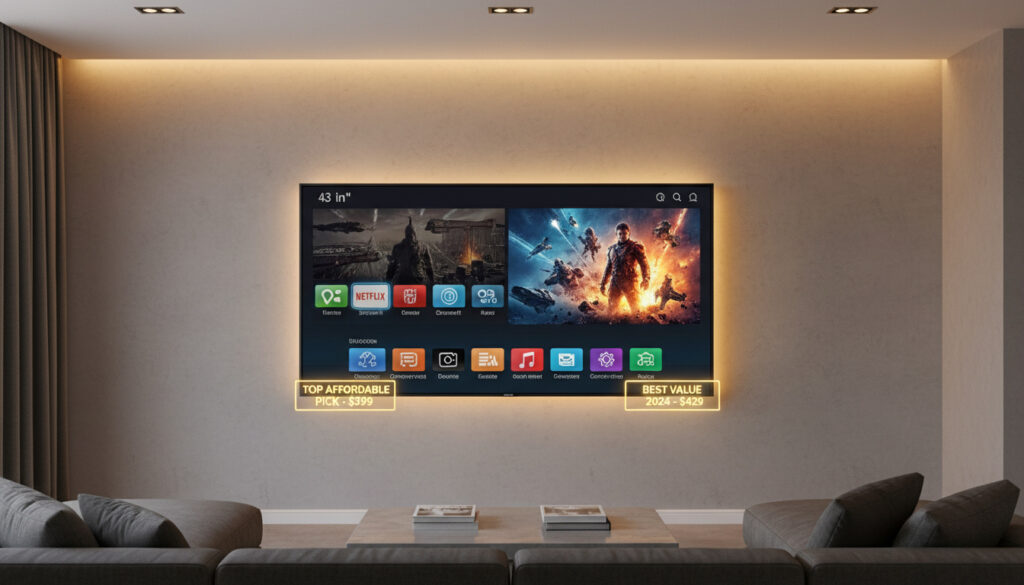
43 Inch Smart TV – Best Budget Picks 2024
The 43-inch smart television occupies a distinct niche in the display market. It bridges the gap between desktop monitors and traditional living room screens, offering sufficient real estate for 4K content without overwhelming modest spaces.
Current market analysis reveals a sharp bifurcation at this size point. Budget-conscious consumers find viable options between $230 and $300 from manufacturers like TCL, Hisense, and Amazon. Conversely, premium technologies including OLED and Mini-LED configurations from LG and Samsung typically command prices starting near $600 and extending well beyond.
This examination focuses on verified performance data, documented pricing structures, and spatial requirements to inform purchasing decisions without speculative projections.
What Is the Best 43-Inch Smart TV?
Determining the optimal model requires balancing operating system preferences, panel technology, and budget constraints. Independent testing organizations consistently identify four primary contenders in the sub-$300 category, each with distinct ecosystem advantages.
| Model | Price Range | Key Feature | Rating |
|---|---|---|---|
| Amazon Fire TV Omni QLED 43″ | $250–$300 | QLED Panel, Fire OS | 4.0/5 |
| TCL 43″ Class 4-Series Roku | $230–$280 | Roku Interface, 4K HDR | 4.0/5 |
| Hisense 43″ A6/A6K | $230–$300 | Dolby Vision, Google TV | 4.0/5 |
| Roku Select Series 43″ 4K | $230–$300 | Native Roku OS, Simplified UI | 4.0/5 |
Critical insights emerge from comparative testing across multiple review platforms:
- QLED technology has migrated into budget segments previously dominated by standard LED, with Amazon’s Omni QLED representing this shift at approximately $250–$300 sale prices.
- Roku maintains dominance in user interface simplicity, though Google TV continues gaining market share through integration with Android ecosystems.
- Dolby Vision support, once reserved for mid-range displays, now appears in entry-level Hisense models.
- Refresh rates remain limited to 60Hz across all sub-$300 options, regardless of marketing terminology.
- HDMI 2.1 ports are absent from budget 43-inch configurations, restricting advanced gaming features.
- Typical power consumption ranges between 50–70 watts during active use, with minimal variation between brands.
| Specification | Budget Segment Standard |
|---|---|
| Ideal Room Dimensions | 10 × 12 feet (3 × 3.6 meters) |
| Optimal Viewing Distance | 5–7 feet (1.5–2.1 meters) |
| Native Resolution | 3840 × 2160 (4K UHD) |
| Panel Refresh Rate | 60Hz |
| HDMI Port Requirement | Minimum 3 inputs, 1 with eARC |
| HDR Format Support | HDR10 baseline, Dolby Vision preferred |
| Operating Systems | Roku, Fire TV, Google TV |
| Price Floor (2024–2026) | $230–$300 |
Best 43-Inch Smart TV for Gaming and Features
Gaming performance and smart features present the primary differentiators between budget and premium tiers. Understanding technical limitations prevents mismatched expectations.
Gaming Performance Constraints
Budget 43-inch televisions uniformly utilize 60Hz panels. This specification limits output to 60 frames per second, adequate for casual PlayStation 5 or Xbox Series S gameplay but insufficient for competitive titles requiring 120Hz refresh rates. RTINGS testing confirms that HDMI 2.1 functionality, variable refresh rate (VRR), and auto low latency mode (ALLM) remain absent from sub-$300 models.
Input lag measurements in “Game Mode” typically register between 10–15 milliseconds on TCL and Hisense units, acceptable for single-player experiences. However, fast-twitch shooters and fighting games benefit from the sub-10ms response times found exclusively in premium tiers like the LG C5 OLED or Samsung QN90 series.
Smart Platform Ecosystems
Operating system selection impacts daily usability more than marginal picture quality differences. Video analysis demonstrates that Roku TV provides the most stable experience on limited hardware, while Google TV offers superior personalization but demands more processing power.
Roku TV suits users prioritizing speed and simplicity, while Amazon Fire TV benefits households already invested in Alexa ecosystems. Google TV serves Android users requiring Google Cast functionality.
No 43-inch television under $300 currently supports 4K/120Hz output or VRR technology. Serious gamers requiring these specifications must budget $600+ for the LG C5 OLED or Samsung QN90F.
What Size Room Is Ideal for a 43-Inch TV?
Spatial planning determines whether a 43-inch display satisfies viewing requirements or necessitates upgrading to a larger format.
Viewing Distance Mathematics
For 4K resolution, the optimal viewing distance spans 5 to 7 feet (1.5 to 2.1 meters). Technical guidelines suggest that distances under 5 feet risk revealing individual pixels, while exceeding 8 feet diminishes the perceptual benefit of 4K detail. These constraints make the 43-inch format ideal for bedrooms, home offices, and dormitory environments rather than expansive living rooms.
Spatial Applications
Bedroom installations represent the primary use case, followed by kitchen counter setups and RV installations. The form factor accommodates wall mounting in spaces where larger displays would overwhelm the architecture. Users with seating distances consistently exceeding 9 feet should consider 50-inch or 55-inch alternatives to maintain immersive viewing angles.
TCL vs Hisense vs Samsung: Price and Performance Reality
Direct manufacturer comparisons reveal distinct value propositions at the 43-inch size. TCL and Hisense compete aggressively in the $230–$300 bracket, while Samsung reserves its advanced technologies for significantly higher price points.
Retailer data indicates that TCL’s 4-Series provides the most reliable Roku experience, whereas Hisense A6 variants offer Dolby Vision support absent from equivalently priced competitors. Samsung’s 43-inch offerings, including the Q60C and QN90F, utilize Tizen operating systems and QLED or Neo QLED panels, but pricing typically starts at $400 and extends to $800+ for the Mini-LED configurations.
Retail pricing fluctuates significantly during promotional periods. The Amazon Fire TV Omni QLED periodically drops to $250 during Prime Day events, while TCL and Hisense models see comparable reductions during Black Friday sales cycles.
Evolution of Budget 43-Inch Technology
The budget 43-inch segment has undergone significant technological democratization over the past four years.
- : Roku TV establishes dominance in the budget sector through partnerships with TCL and Hisense, capturing significant market share with simplified interface designs.
- : Google TV adoption accelerates among cost-conscious manufacturers, though performance issues persist on entry-level hardware with limited RAM.
- : Mini-LED backlighting enters the sub-$400 category through Hisense U6N and similar models, previously restricted to flagship displays.
- : Industry analysts anticipate 120Hz native panels filtering into sub-$400 43-inch models, though current predictions remain unverified by shipping hardware.
Established Facts vs. Market Uncertainties
| Verified Information | Remaining Uncertainties |
|---|---|
| 43-inch displays require 5–7 foot viewing distances for optimal 4K perception | Long-term software update support commitments from budget manufacturers |
| Budget tier consistently priced $230–$300 during non-promotional periods | Exact release timelines for 120Hz-capable sub-$400 models |
| 60Hz maximum refresh rate on all sub-$300 models | Regional pricing variations outside North American markets |
| Dolby Vision now available in entry-level Hisense configurations | Sustainability ratings and repairability scores for specific budget models |
The 43-Inch Form Factor in Modern Homes
Streaming enthusiasts should first consider their subscription costs, particularly when evaluating How Much Is YouTube Premium UK, before selecting a display. The 43-inch size has emerged as the default choice for secondary viewing environments, replacing traditional 32-inch and 40-inch models that dominated bedroom installations throughout the previous decade.
This transition reflects changing consumption patterns. Users increasingly demand 4K resolution and full smart TV capabilities in spaces previously served by basic displays. The physical dimensions—approximately 38 inches wide by 22 inches tall without stands—accommodate standard furniture depths while maintaining sufficient screen presence for individual or paired viewing.
Expert Evaluations and Testing Data
Independent testing organizations provide crucial context beyond manufacturer specifications.
“TCL excels in value proposition for the 43-inch category, delivering color accuracy within acceptable Delta E ranges for the price point.”
— RTINGS Laboratory Analysis, 2024
“Samsung maintains superiority in color volume and brightness consistency, though this performance requires investment in the Neo QLED series rather than entry-level Crystal UHD models.”
— TechRadar Technical Review
Final Selection Framework
Selecting the appropriate 43-inch smart television requires honest assessment of primary use cases. Streaming-focused users prioritizing interface simplicity should gravitate toward TCL or Roku-branded options. Those embedded within Amazon ecosystems benefit from the Omni QLED’s integration, despite its interface limitations. When ready to purchase, understanding How to Use Apple Pay can streamline transaction processing through supported retailers.
Frequently Asked Questions
Is 43 inches big enough for a living room?
For living rooms with seating distances under 7 feet, 43 inches proves adequate. Spaces with viewing distances exceeding 9 feet benefit from 50-inch or larger displays to maintain immersive visual perception.
What upcoming 43-inch models should buyers anticipate?
Manufacturers plan 120Hz panel introductions for budget tiers in 2025, though specific model numbers and pricing remain unannounced. Mini-LED technology continues expanding downward from premium price brackets.
What differentiates TCL from Hisense at this size?
TCL prioritizes Roku interface stability and consistent manufacturing quality, while Hisense emphasizes Dolby Vision support and Google TV integration. Both utilize similar 60Hz panels and comparable brightness levels.
Can budget 43-inch TVs serve as computer monitors?
While functional for casual computing, 43-inch televisions exhibit higher input lag and lower pixel density than dedicated monitors. Chroma subsampling limitations may also reduce text clarity during productivity tasks.
Should I choose Roku or Fire TV for a bedroom installation?
Roku provides faster boot times and less intrusive advertising for bedroom environments. Fire TV offers superior voice control through Alexa but requires Amazon account integration that some users find restrictive.
More related posts
 The Thick Of It – Clever Political Satire Analysis
 Premier League Results Today – Live Scores, Table & Updates
 World Cup 2026 Draw: Groups, Fixtures, and Results
 Royal Holloway University of London Ranking – UK 35th, QS 461st Analysis
 What Is Garden Leave? Definition, Rules, and Examples
 How Much Is YouTube Premium UK – Prices and Plans 2024
 Stay Updated Always TXEPC – AI Curation and Notification Guide
 157 cm in Feet & Inches: Converter, Chart, Height Guide