Air Force 1 Plane – Interior, Defenses and Costs
Air Force One stands as one of the most recognizable aircraft in the world, serving as a floating White House whenever the President of the United States travels. The current fleet consists of two highly customized Boeing 747-200B aircraft designated VC-25A, operating under the call signs SAM 28000 and SAM 29000. These massive aircraft have transported every U.S. president since their introduction in 1990, functioning as command centers, communication hubs, and symbols of American executive power.
The engineering behind Air Force One extends far beyond typical commercial aviation. Each aircraft features approximately 4,000 square feet of interior space organized across three distinct levels, with the upper deck housing the cockpit and communications center while the main deck accommodates passengers and the presidential executive suite. The aircraft can carry slightly more than 70 passengers and features specialized systems designed for self-sufficiency during extended operations.
A replacement program is currently underway, with the next-generation VC-25B being constructed on the Boeing 747-8 airframe. This new fleet promises enhanced capabilities and a modernized interior, though questions remain about operational costs, specific defense systems, and real-time tracking capabilities that continue to generate public interest.
What is inside the Air Force One plane?
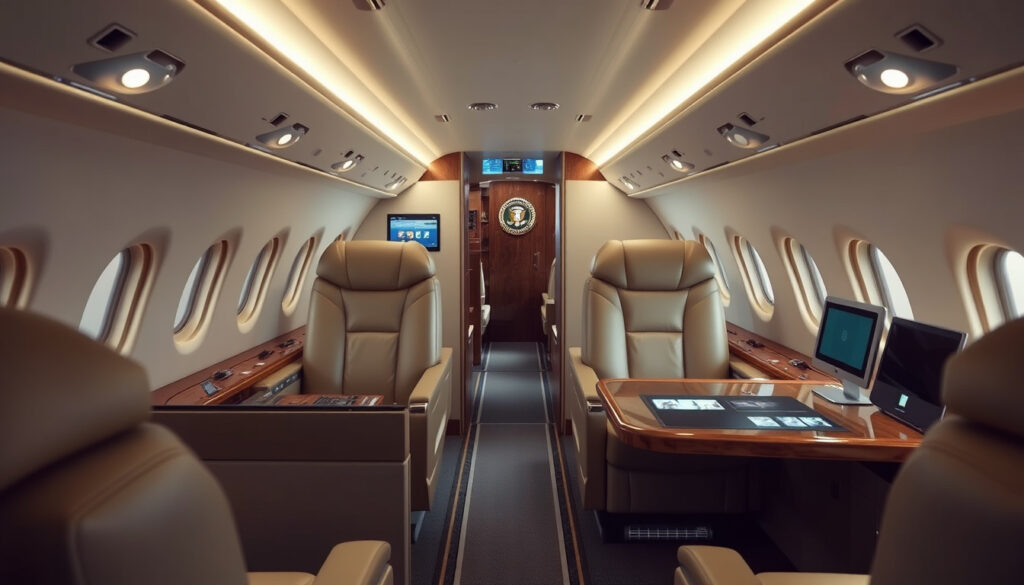
The interior of the VC-25A reflects decades of evolution in presidential travel accommodations. First Lady Nancy Reagan oversaw the original interior design, which features American Southwest decor that has remained largely unchanged since the aircraft entered service in 1990. The aircraft’s three-level layout serves distinct purposes, with the lower deck primarily handling cargo for luggage and food supplies while the main and upper decks accommodate passengers and critical systems.
The front section of the main deck is informally called the “White House” within the aircraft. The presidential executive suite includes a stateroom with sleeping quarters featuring two couches convertible into beds, along with a lavatory equipped with a shower, vanity, double sink, and a private office sometimes referred to as the president’s “Oval Office aboard Air Force One.” The president also has access to a conference and dining room, allowing official business to continue during travel.
- Interior spans approximately 4,000 square feet across three levels
- Two galleys can prepare up to 100 meals at one sitting
- Six passenger lavatories include disabled access facilities
- Carpet quality gradually improves from rear to front, serving as protocol indicator
- Medical compartment handles minor emergencies
- Separate accommodations exist for guests, staff, Secret Service, and media
| Fact | Details |
|---|---|
| Tail Codes | SAM 28000, SAM 29000 |
| Manufacturer | Boeing |
| Base Model | Boeing 747-200B |
| Interior Designer | Nancy Reagan (First Lady) |
| Passenger Capacity | Slightly more than 70 |
| Crew Size | 26 crew members |
| Service Entry | August 23, 1990 |
| Air Refueling | Yes, providing near-unlimited range |
The aircraft features a subtle but deliberate design element where carpet quality indicates rank and proximity to the president. Industrial-grade carpet occupies the rear sections where press members typically sit, while the presidential area features beige carpet adorned with gold stars.
The Presidential Suite and Living Quarters
The presidential stateroom represents the most private space aboard the aircraft. Beyond the convertible couches serving as beds, the suite includes a comprehensive bathroom facility with shower capabilities, a vanity area, and double sinks. The private office adjacent to the sleeping quarters enables the president to conduct sensitive communications and official business while airborne, reinforcing the “flying Oval Office” concept that defines Air Force One’s operational philosophy.
Accommodations for other official passengers follow a hierarchical arrangement. Guests, senior staff members, Secret Service personnel, and news media representatives each have designated areas reflecting their roles during presidential travel. This structured layout ensures both security protocols and operational efficiency during flights that may span thousands of miles and multiple time zones.
Flight Deck and Cockpit Configuration
The cockpit accommodates four crew members: two pilots, a navigator, and a flight engineer. Situated 29 feet above the ground, the flight deck sits approximately 100 feet in front of the main landing gear and 12 feet ahead of the nose gear. Despite the enormous size of the 747 airframe, the flight deck itself is essentially identical in dimensions to earlier VC-137C presidential aircraft, maintaining familiar controls and visibility for pilots transitioning between models.
What weapons and defense systems does the Air Force One plane have?
Specific details regarding offensive weapons systems aboard Air Force One remain classified, with official sources offering limited public information about direct defensive capabilities. The aircraft is not designed for combat operations in the traditional sense, but rather functions as a protected command and communication platform capable of maintaining operations during various crisis scenarios.
The upper deck has been described by defense analysts as a “flying data center,” featuring extensive racks of servers, cables, and cooling systems distributed throughout multiple bulkheads. The Mission Communications Suite located behind the flight crew measures 50 percent larger than comparable systems on previous presidential aircraft, containing far more than standard communications gear found on comparable aircraft.
The MCS enables secure communications worldwide, allowing the president to maintain contact with military commanders, government officials, and international leaders regardless of location. This capability transforms Air Force One into a fully functional command center during national emergencies.
The nose section includes an air refueling receptacle enabling in-flight refueling, which effectively provides “almost unlimited range” for the aircraft. This feature allows extended missions without landing, potentially keeping the president airborne for extended periods during security threats. The rear fuselage contains contour changes specifically designed to accommodate special equipment related to the presidential mission.
Defense analysts have speculated that some equipment serves a “Doomsday” scenario purpose, designed to allow the commander-in-chief to remain airborne during the outbreak of nuclear war or similar catastrophic events. While these reports remain unconfirmed through official channels, the aircraft’s self-sufficiency features and communication capabilities suggest preparation for extreme contingencies.
Self-Sufficiency Features
The VC-25A includes a second Garrett AiResearch GTC331-200 auxiliary power unit that ensures complete self-sufficiency on the ground. This backup system allows the aircraft to operate from locations without extensive ground support infrastructure, expanding potential landing options during emergencies when traditional airports might be compromised or unavailable.
How much does the Air Force One plane cost?
Precise cost figures for Air Force One operations remain difficult to establish from public sources. The research available indicates an hourly operating cost figure of approximately $3,433, though this figure appears to derive from video documentation rather than official government accounting. Detailed budget breakdowns for maintenance, fuel, crew rotation, and infrastructure support are not publicly disclosed.
The original VC-25A aircraft were built on modified Boeing 747-200B airframes, with customizations for presidential requirements adding substantially to base aircraft costs. The current VC-25B replacement program, utilizing Boeing 747-8 airframes, represents a significant investment in next-generation presidential transportation capabilities. Boeing has confirmed that the new aircraft will provide increased capacity and enhanced features compared to the current fleet.
Official government sources do not publish comprehensive operating costs for Air Force One. Individual figures cited in various media may not reflect total expenses including maintenance, crew, security, and ground support operations.
The planned interior upgrades for the VC-25B include a modernized presidential suite replacing the current presidential futon with an actual queen-sized bed, expanded personal lounge areas featuring additional recliners and sofas, and completely revamped remaining interior spaces. The design direction moves away from the earth-toned, nature-inspired color scheme that has characterized Air Force One since the 1960s.
How can you track the Air Force One plane live?
Real-time tracking of Air Force One presents unique challenges due to the aircraft’s security requirements and operational classification. While various flight tracking services exist for general aviation, military aircraft including presidential transports typically do not appear on public tracking platforms when operating under classified or sensitive mission parameters.
Standard flight tracking applications may occasionally display VC-25A aircraft when they operate under civilian air traffic control transponder codes during routine presidential travel. However, during sensitive operations, these transponders may be switched to codes that limit or exclude public tracking information. The distinction between “Air Force One” and “SAM 28000/29000” further complicates tracking, as the famous call sign applies only when the president is actually aboard.
Questions about whether Air Force One is currently grounded also lack straightforward answers in public sources. The aircraft maintain operational readiness for presidential travel requirements, and both VC-25As have been observed flying in recent years. Without access to official Air Force operational status reports, confirming current grounded status or specific mission schedules remains difficult through unclassified channels.
Understanding Presidential Flight Operations
The White House has historically maintained discretion over revealing presidential travel schedules in advance due to security considerations. Advance teams typically scout destinations, coordinate with local authorities, and establish security perimeters before any public announcement of presidential arrivals. This operational security extends to flight tracking, where premature disclosure of aircraft movements could create vulnerabilities.
For the most current information regarding Air Force One operations, official Air Force or Department of Defense sources represent the most reliable channels. Some news organizations maintain correspondents who cover presidential travel and may provide updates through their coverage platforms, though even these sources operate within constraints established by Secret Service protocols.
Timeline of Air Force One Development
The evolution of presidential air transportation reflects changing security environments and technological capabilities throughout American history. From the initial use of commercial aircraft to dedicated military transports, each generation of presidential aircraft has addressed emerging requirements for command, communication, and protection.
- 1990: Current VC-25A fleet officially enters presidential service, replacing earlier VC-137C aircraft
- Ongoing: VC-25B replacement program progresses using Boeing 747-8 airframes
- Planned: Next-generation aircraft to feature enhanced communications, increased capacity, and modernized interior
The VC-25A introduction on August 23, 1990, marked a significant upgrade in presidential transportation capabilities. Both aircraft, SAM 28000 and SAM 29000, remain virtually identical inside and out, allowing seamless operations regardless of which specific airframe the president selects for any given mission. This redundancy ensures continuous availability even during maintenance periods.
What is confirmed versus uncertain about Air Force One?
| Established Information | Information That Remains Unclear |
|---|---|
| Two active VC-25A aircraft in presidential service | Specific defense systems beyond communications suite |
| Boeing 747-200B base platform with extensive modifications | Total program and lifetime operating costs |
| Approximately 4,000 square feet of interior space | Real-time flight tracking availability |
| Mission Communications Suite provides global connectivity | Current grounded or operational status |
| Air-to-air refueling capability for extended range | Specific weapons system configurations |
| VC-25B replacement program using Boeing 747-8 | Historical movie appearances and cultural impact |
The aircraft’s role as a command center during national emergencies represents confirmed capability, though specific implementation details remain classified. Communication systems receive extensive coverage from official sources, establishing the upper deck’s function as a “flying data center” with enhanced capabilities compared to predecessors. The general layout and accommodation arrangements for passengers are well-documented through various media presentations over the years.
Information regarding classified defense capabilities, real-time operational status, and detailed cost structures requires consultation of official Air Force or Department of Defense sources. Many aspects of presidential aircraft operations remain protected for security reasons.
Historical Context and Significance of Air Force One
The designation “Air Force One” applies specifically whenever the President of the United States is aboard any Air Force aircraft, creating a unique call sign that carries substantial symbolic weight. The term entered common usage following a 1953 incident where a commercial airline coincidentally used the same call sign as the presidential aircraft, prompting adoption of the more distinctive “Air Force One” designation to prevent confusion during critical communications.
The aircraft’s role extends far beyond simple transportation. Every president since Franklin D. Roosevelt has used aircraft for executive travel, but the modern VC-25A represents the culmination of decades of experience in mobile presidential command. The ability to conduct international diplomacy, manage crises, and maintain continuous communication while traveling represents a fundamental shift in executive branch operations compared to earlier eras.
Security considerations have shaped virtually every aspect of Air Force One’s design and operation. From self-sufficiency features allowing operation from remote locations to communication systems enabling secure contacts with military commanders worldwide, the aircraft reflects evolving threat assessments and operational requirements accumulated over generations of presidential air travel.
Official Sources and Expert References
“The aircraft includes a stateroom with sleeping quarters featuring two couches convertible into beds, a lavatory with shower, vanity, double sink, and a private office sometimes called the president’s ‘Oval Office aboard Air Force One.'” — Official Air Force Fact Sheet
“The VC-25A is a highly modified Boeing 747-200B with approximately 4,000 square feet of interior space.” — Boeing Defense, Space & Security
The most authoritative public sources for Air Force One information include the White House official page on presidential aircraft, Boeing’s defense division documentation, and the United States Air Force fact sheet series. The Defense Media Network has provided detailed interior tours that offer glimpses into typically restricted areas, though certain features remain outside public disclosure parameters.
What comes next for Air Force One?
The VC-25B program represents the most significant update to presidential air transportation since 1990. Built on the Boeing 747-8 platform, these new aircraft will offer increased capacity and enhanced capabilities including a completely modernized presidential suite featuring a queen-sized bed rather than convertible couches, expanded lounge areas, and updated technological infrastructure throughout.
The transition to the new fleet will eventually retire the aging VC-25A aircraft that have served for over three decades. Each aspect of the replacement process involves careful coordination between the Air Force, Boeing, and presidential security teams to ensure uninterrupted capability during the transition period.
For readers interested in related topics, the Air Force 1 Black – Sizing for Men, Women, Juniors guide explores the popular Nike sneaker line that shares the presidential aircraft’s famous designation, while Cast of Hijack (TV Series) – Full Season 1 List, Hijackers & Season 2 examines a recent television production featuring fictionalized presidential aircraft scenarios.
Frequently Asked Questions
How many aircraft make up the current Air Force One fleet?
Two VC-25A aircraft designated SAM 28000 and SAM 29000 currently serve as Air Force One. Both are virtually identical and can operate interchangeably depending on maintenance availability and operational requirements.
Can Air Force One be tracked in real time?
Real-time public tracking of Air Force One is limited due to security protocols. The aircraft may appear on some flight tracking services when operating under civilian transponder codes, but classified missions may not display publicly.
What movies have featured Air Force One?
The aircraft has appeared in numerous films, with the 1997 action film “Air Force One” starring Harrison Ford being among the most notable theatrical portrayals. Documentary productions have also featured the aircraft in various contexts.
Is Air Force One currently grounded?
Public sources do not confirm whether Air Force One is currently grounded. Both VC-25A aircraft have been observed in operation recently, and the VC-25B replacement program continues under development with Boeing.
What defense capabilities does Air Force One have?
Specific weapons systems remain classified. The aircraft features advanced communications capabilities, self-sufficiency for extended operations, and air-to-air refueling capability. Direct combat defense features are not publicly documented.
How much does it cost to operate Air Force One per hour?
Some sources cite approximately $3,433 per hour, though comprehensive cost data including maintenance, crew, security, and infrastructure is not publicly available from official government sources.
What upgrades will the VC-25B bring?
The VC-25B will feature a modernized presidential suite with a queen-sized bed, expanded lounge areas, updated design throughout, and increased overall capacity compared to the current VC-25A fleet.
More related posts
 600 Euro in Pound : Live Rate & Conver ion (2026)
 What Does SOS Stand For? Real Meaning, Origin & Myths
 Air Fryer Jacket Potato: Crispy & Fluffy in 45 Minutes
 When Do the Clocks Go Back in the UK in 2025? Date and Sleep Tips
 Laura Fraser Movies and TV Shows – Three-Decade Career Overview
 Liverpool Christmas Markets 2025 – Dates, Location and Full Guide
 Best Mum to Be Gifts: Ireland Ideas for Expectant Mums
 Best Earplugs for Sleeping – Top Lab-Tested Picks