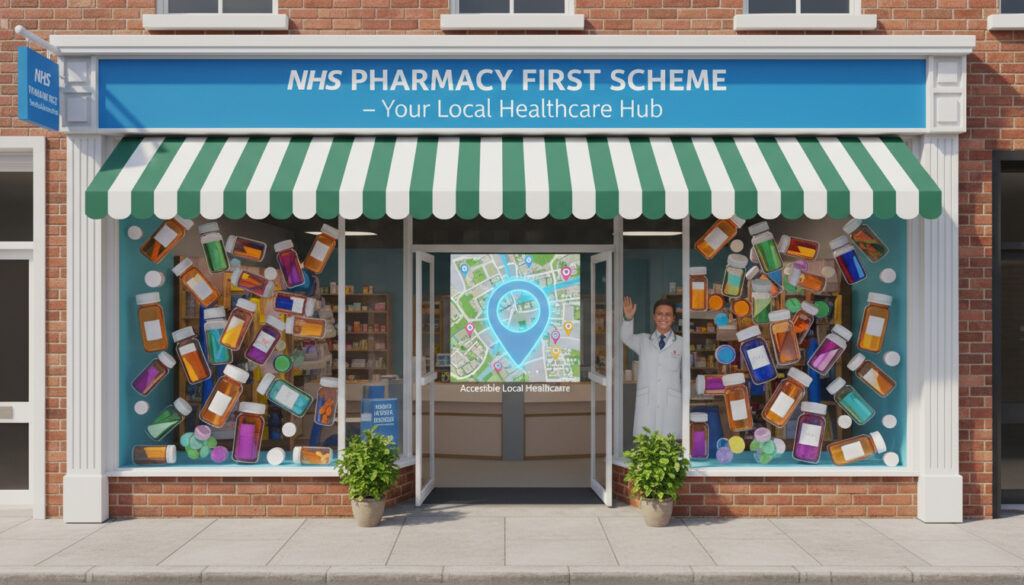
Pharmacy First Scheme Near Me – Find Participating Pharmacies
The NHS Pharmacy First scheme represents a fundamental shift in how England handles minor ailments, offering patients direct access to professional treatment without the traditional GP bottleneck. Launched nationwide on 31 January 2024, this advanced service empowers community pharmacists to diagnose and treat seven common conditions using NHS-funded prescription medicines.
For anyone seeking immediate healthcare solutions, understanding how to locate participating pharmacies and verify eligibility proves essential. The service operates through registered community pharmacies across England, replacing the previous Community Pharmacist Consultation Service with a more comprehensive clinical offering.
Unlike traditional prescribing routes, Pharmacy First enables qualified pharmacists to supply restricted medicines via Patient Group Directions after assessing symptoms in private consultation rooms.
What is the Pharmacy First Scheme?
NHS minor ailment treatment delivered by trained community pharmacists
31 January 2024 across England
Seven common conditions including sinusitis, sore throat, and earache
No GP referral required; walk-in consultations available
- Replaces CPCS: The Community Pharmacist Consultation Service ended on 30 January 2024, with Pharmacy First commencing the following day.
- Prescription Authority: Pharmacists can supply restricted prescription-only medicines including antibiotics and antivirals under specific clinical pathways.
- Universal GP Registration: Available to all patients registered with a general practitioner in England.
- Private Consultations: Assessments occur in dedicated consultation rooms, maintaining patient confidentiality.
- Quarterly Caps: From October 2024, pharmacies face a maximum limit of 30 consultations per pathway per month.
- Referral Fees: Pharmacies receive £15 for each completed minor illness referral from NHS 111 or general practices.
| Fact | Details |
|---|---|
| Official Launch | 31 January 2024 |
| Predecessor Service | Community Pharmacist Consultation Service (CPCS) |
| Geographic Scope | England only |
| Conditions Covered | 7 specified minor ailments |
| Medicine Supply Method | Patient Group Directions (PGDs) |
| Pharmacy Requirements | Consultation room, otoscope, IT system, training, SOPs |
| Prescription Charges | Standard NHS rates apply (free for exempt patients) |
| Referral Mechanism | Direct walk-in or referral from NHS 111/GP/999 |
How Do I Find a Pharmacy First Location Near Me?
Locating a participating pharmacy requires understanding the distinction between professional tools and public access. Healthcare professionals utilise the NHS Service Finder to identify specific Pharmacy First locations, while members of the public should contact local pharmacies directly or check the NHS website for participating branches. What Is My Postcode can help determine which pharmacies fall within your immediate vicinity.
All community pharmacies in England must provide the full Pharmacy First service after completing registration through the NHSBSA Manage Your Service portal. However, distance-selling pharmacies—those operating primarily online—cannot offer consultations for acute otitis media due to the physical requirement for an otoscope examination.
Look for Pharmacy First signage in pharmacy windows or ask staff directly whether they offer the full clinical pathway service. Registration requires premises to maintain private consultation rooms and specific diagnostic equipment including otoscopes.
Which Pharmacies Near Me Offer the Full Service?
Participation depends on infrastructure compliance. Pharmacies must demonstrate adequate consultation facilities, IT systems capable of NHS integration, and staff completion of mandated training programmes. The service specification published by NHS England outlines these requirements explicitly.
What Conditions Does Pharmacy First Cover?
The scheme addresses seven specific minor ailments through standardised clinical pathways developed in collaboration with NICE, general practitioners, and clinical experts. These pathways ensure consistent, evidence-based treatment across all participating locations.
The Seven Clinical Pathways
- Sinusitis: Acute bacterial sinusitis in adults
- Sore Throat: Including suspected streptococcal infections
- Earache: Acute otitis media, typically in children
- Infected Insect Bite: Localised bacterial infections
- Impetigo: Bacterial skin infection
- Shingles: Viral reactivation requiring antivirals
- UTIs: Uncomplicated urinary tract infections in women aged 16-64
What Medicines Can Pharmacists Prescribe?
Pharmacists supply NHS-funded prescription-only medicines only when clinically appropriate per the defined pathways. The Centre for Pharmacy Postgraduate Education confirms that supplies include specific antibiotics for bacterial infections and antivirals for shingles, with reimbursement processed through the NHS Drug Tariff.
Distance-selling pharmacies cannot conduct ear examinations as these require physical otoscope equipment. Patients requiring earache treatment must visit brick-and-mortar pharmacies with appropriate diagnostic facilities.
Who Is Eligible and How Does It Work?
Eligibility centres on GP registration status and specific age or condition restrictions. The process emphasises patient safety through red flag identification and clear referral pathways for complex cases.
Who Qualifies for Pharmacy First?
Patients must register with a GP in England to access the service. Pathway-specific restrictions apply: urinary tract infection treatment limits eligibility to women aged 16-64, while acute otitis media pathways typically focus on paediatric cases. Department of Health guidance confirms that normal prescription charge rules apply to any medicines supplied.
Do I Need an Appointment?
No formal appointment is required for the seven condition pathways. Patients may walk into participating pharmacies during opening hours, though some locations offer telephone triage first. Consultations occur in private rooms where pharmacists assess symptoms, identify red flags requiring GP referral, and supply medicines if appropriate.
Is Pharmacy First Free?
The consultation itself carries no charge. However, prescription medicines follow standard NHS charging rules—patients exempt from prescription charges receive medicines free, while others pay the current NHS prescription rate. Community Pharmacy England documentation clarifies that pharmacies receive no payment if they cannot complete a supply.
Pharmacies claim reimbursement for medicines via the Drug Tariff. For minor illness referrals from NHS 111 or urgent care, they receive a £15 fee per completed consultation, as detailed in NHS Business Services Authority documentation.
When Did Pharmacy First Launch and Evolve?
- : Pilot phases and preparatory training programmes initiated across selected pharmacy sites
- : National rollout across England, replacing the Community Pharmacist Consultation Service
- : First activity claims processed through the NHS Business Services Authority
- : Fee structure updated to cap pharmacies at 30 consultations per pathway per month
- : Service continues under the expanded community pharmacy contractual framework published on Gov.uk
What is Confirmed and What Remains Variable?
| Established Facts | Uncertain or Variable Elements |
|---|---|
| Launch date of 31 January 2024 | Real-time availability of specific appointment slots at individual pharmacies |
| The seven conditions covered nationwide | Exact number of participating pharmacies at any given moment (registration ongoing) |
| Mandatory service provision for registered community pharmacies | Regional variations in consultation waiting times during peak periods |
| Prescription charge rules matching standard NHS regulations | Individual pharmacist availability for specific pathway specialisations |
Why Did the NHS Introduce Pharmacy First?
The scheme emerged from mounting pressure on general practice appointments, with NHS England seeking to redirect appropriate minor ailment cases to community pharmacies. By enabling direct access to prescription medicines for uncomplicated conditions, the service aims to reduce GP workload while providing faster treatment access for patients.
The three-pillar structure—clinical pathways for seven conditions, minor illness referrals from other NHS services, and urgent repeat medicine supply—creates a comprehensive safety net. However, NHS training documentation emphasises that red flag symptoms require immediate GP or emergency department referral, maintaining appropriate clinical boundaries.
What Are the Official Sources?
“The NHS Pharmacy First scheme enables community pharmacies to provide consultations, advice, and NHS-funded treatments for seven common conditions without a GP appointment or prescription in most cases.”
NHS England Service Specification
Official documentation originates from NHS England’s primary care pharmacy division, supplemented by implementation guidance from the Centre for Pharmacy Postgraduate Education and the NHS Business Services Authority. The complete service specification provides technical details for healthcare professionals.
How Can I Access Pharmacy First Today?
Patients requiring treatment for the seven specified conditions should locate their nearest participating community pharmacy, confirm they meet pathway-specific criteria, and attend for a private consultation. Fence Panels Near Me reminds us that local service directories remain essential tools for connecting with nearby resources, whether for healthcare or home improvements.
Can children access Pharmacy First?
Yes, children can receive treatment for appropriate conditions such as acute otitis media (earache), though specific age restrictions apply to certain pathways like UTI treatment.
What happens if I need more complex treatment?
Pharmacists assess for red flags during consultations. If symptoms suggest serious illness or complications, they refer patients to general practitioners or emergency departments immediately.
Do I need my NHS number to use the service?
While not explicitly required in all cases, bringing your NHS number helps pharmacies verify your GP registration status and process any medicine supplies efficiently.
Can any pharmacy refuse to provide the service?
All registered community pharmacies must provide the service if they meet infrastructure requirements. However, if a pharmacy lacks necessary equipment or trained staff on duty, they may refer you to alternative locations.
How long does a typical consultation take?
Consultation duration varies by condition complexity, but most assessments for the seven minor ailments conclude within 15 to 20 minutes, including diagnosis and treatment provision.
More related posts
 157 cm in Feet & Inches: Converter, Chart, Height Guide
 Cast of Vikings TV Series: Main Actors, Salaries, History
 Conrad The Summer I Turned Pretty – Complete Character Guide
 When Is Coronation Street On This Week – ITV1 Schedule April 2026
 Benefits of Apple Cider Vinegar – Science-Backed Effects and Risks
 How to Kill Maggots Instantly: Proven Methods for Any Surface
 Silo TV Series Season 3: Premiere Date, Cast & Reviews
 HMRC Telephone Number Free: Official Helpline & Refund Guide