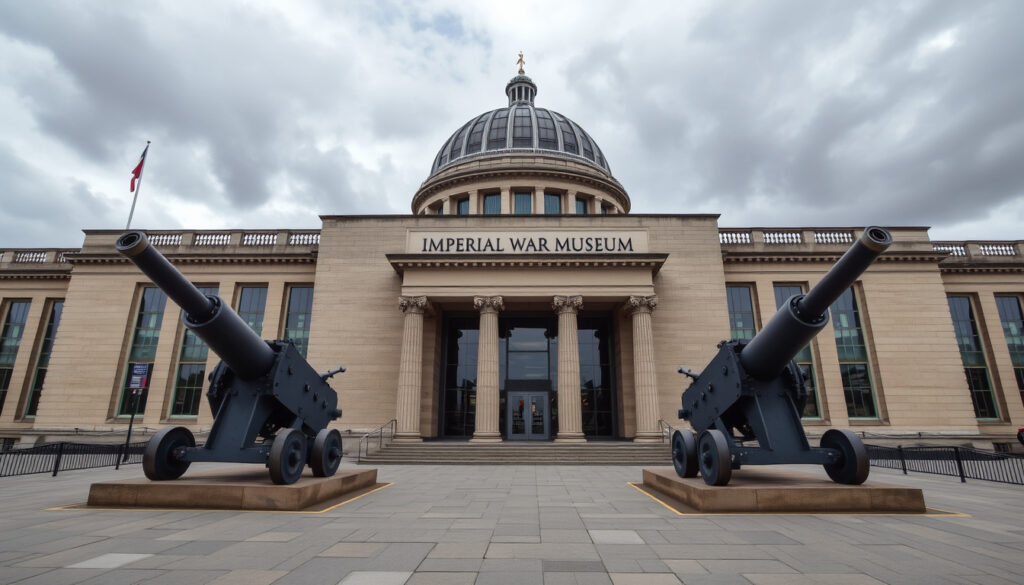
Imperial War Museum London: Free Entry & Visitor Guide
There’s a reason the Imperial War Museum London has been drawing visitors for over a century: it tells the story of war through the eyes of the people who lived through it. Whether you’re a history buff or a family looking for a free day out, IWM London offers a powerful, thought-provoking experience.
Founded: 1917 · Free entry: Yes · Nearest tube: Lambeth North · Opening hours: 10:00–18:00 daily · Type: War museum · Branches: 5
Quick snapshot
- Permanent galleries are free for all visitors (Imperial War Museums)
- Timed tickets are required, book online (IWM ticket FAQ)
- Donations are welcome to support the charity (Visit London)
- Nearest tube: Lambeth North (Bakerloo line) – 7-minute walk (IWM getting here)
- Open daily 10:00–18:00 (Imperial War Museums)
- First World War Galleries – immersive and award-winning
- The Holocaust Exhibition – a permanent, sobering display
- Tanks, artillery and aircraft from WWI to present day
Seven key facts, one pattern: nearly every practical detail is designed to make history accessible. The table below distils the essential information.
| Fact | Value |
|---|---|
| Full name | Imperial War Museum London |
| Location | Lambeth Road, London SE1 6HZ (Free Tours by Foot) |
| Established | 1917 (Wikipedia) |
| Free entry | Yes – permanent galleries free (Imperial War Museums) |
| Nearest tube | Lambeth North (Bakerloo line) (IWM getting here) |
| Opening hours | 10:00–18:00 daily (Imperial War Museums) |
| Website | www.iwm.org.uk |
Free admission removes the biggest barrier to entry. The museum relies on donations and bookable special exhibitions to sustain its mission.
Is it free to get into the Imperial War Museum?
Yes – entry to all permanent galleries at IWM London is free for everyone, according to the Imperial War Museums official website. There is no charge for the main collections, which cover conflict from the First World War to the present day.
Are donations requested?
- Donations are welcome and help the museum run as a charity (Visit London)
- Gift Aid can be added to ticket bookings
Is there any paid exhibition?
- Special temporary exhibitions sometimes require a ticket, though the main galleries stay free
- Check the IWM website for current exhibitions and pricing
The implication: free permanent entry makes IWM London one of the best-value cultural attractions in the capital, but donations and paid extras help keep it running.
What is the nearest tube station to the Imperial War Museum?
The closest Underground station is Lambeth North on the Bakerloo line, about a 7-minute walk from the museum entrance (IWM getting here).
Which tube lines serve Lambeth North?
- Only the Bakerloo line serves Lambeth North
- Waterloo (14 min walk) and Elephant & Castle (10 min) offer more lines including Jubilee, Northern, and Borough
How far is the museum from the station?
From Lambeth North it’s a straightforward 7-minute walk along Lambeth Road (IWM getting here). Waterloo is about 14 minutes and Elephant & Castle about 10 minutes – both viable alternatives.
Bakerloo line service can be disrupted at weekends. Check TfL before you travel if you’re relying on Lambeth North.
The trade-off: Lambeth North is the quickest option, but Waterloo gives you more line options if there are delays.
How long does it take to walk around the Imperial War Museum?
Most visitors spend 2–3 hours exploring the permanent galleries, though those keen on every exhibit can take longer (Visit London recommends at least three hours).
Is 2 hours enough?
- For a focused visit without the Holocaust Exhibition, two hours covers the main galleries
- If you want to see everything, plan for three hours or more (Tripadvisor reviews suggest 3+ hours for thorough visits)
What factors affect visit duration?
- Special exhibitions add 30–60 minutes
- Family activities (free on weekends and school holidays) involve extra time (Imperial War Museums)
- Crowd levels – weekends and school holidays are busiest
Why this matters: if you’re on a tight schedule, prioritise the First World War Galleries and the atrium exhibits. The Holocaust Exhibition alone can take an hour.
What is the Imperial War Museum famous for?
IWM London is known for its vast collection of military objects, from a V2 rocket to a Battle of Britain Hurricane. It explores how war shapes lives – covering conflicts from WWI through to modern operations (Imperial War Museums).
What are the top artifacts?
- A full-size Harrier jump jet and a T-34 tank in the atrium
- The Holocaust Exhibition – a permanent, harrowing gallery about the Nazi genocide
- Objects from the First World War trenches and WWII home front
Why is it called Imperial War Museum?
The name reflects its founding in 1917, while the First World War was still being fought. The museum’s original remit was to collect materials from the empire’s war effort (Wikipedia).
Despite the name, the museum’s focus is on personal human experience – not imperial glorification. It’s as much about peace as it is about conflict.
The museum balances historical artifacts with personal stories.
Do I need to book tickets for the Imperial War Museum?
Advance booking is strongly recommended even though entry is free. Timed tickets ensure you don’t queue and help the museum manage capacity (IWM ticket FAQ).
Can I book online?
- Yes – book through the IWM website for free timed-entry slots
- Print your ticket or show the barcode on your phone
Is there a booking fee?
- No – online booking is free. No booking fee applies for general admission.
- Some special exhibitions may have a separate charge.
The catch: you can turn up without a booking, but on busy days you may be turned away or face long queues. Booking ahead gives you a guaranteed entry time.
Pros and Cons of Visiting the Imperial War Museum London
Upsides
- Free entry to world-class galleries
- Excellent transport links (Lambeth North, Waterloo)
- Free family activities on weekends and holidays (Imperial War Museums)
- Powerful, emotionally engaging exhibits
Downsides
- Can be crowded on weekends and during school holidays
- Some exhibitions (like the Holocaust Exhibition) may not be suitable for young children
- Bakerloo line disruption on weekends can complicate travel
- Timed tickets may sell out for peak times
Weighing the upsides and downsides helps visitors decide if IWM London fits their itinerary.
How to Plan Your Visit to the Imperial War Museum London
Follow these steps to make the most of your trip.
- Book your free timed ticket online at iwm.org.uk – no booking fee.
- Check opening hours – 10:00–18:00 daily, closed 24–26 Dec (Imperial War Museums).
- Plan your transport – Lambeth North (Bakerloo) is quickest; Waterloo and Elephant & Castle are alternatives (IWM getting here).
- Allow 2–3 hours for the main galleries, more if seeing everything (Visit London).
- Check for family activities – free trails and workshops run weekends and school holidays (Imperial War Museums).
- Arrive early to avoid peak queues, especially on weekends.
Following these steps ensures a smooth visit.
Timeline: Key Milestones of the Imperial War Museum London
- 1917 – Imperial War Museum founded during WWI (Wikipedia)
- 1920 – Opens at Crystal Palace
- 1924 – Moves to the Imperial Institute in South Kensington
- 1936 – Moves to its current site in Lambeth (Wikipedia)
- 2014 – Major renovation completes, transforming the atrium and galleries (Imperial War Museums)
These milestones show the museum’s evolution over a century.
What We Know and What Remains Unclear
Confirmed Facts
- Free entry for permanent galleries (IWM)
- Nearest tube: Lambeth North (IWM)
- Open 10:00–18:00 daily (IWM)
- Closed 24–26 December (IWM)
- Founded in 1917 (Wikipedia)
What’s unclear
- Exact visit duration varies – 2–4 hours depending on interest
- Peak crowd times are unpredictable – school holidays are busiest
- Exhibits change regularly – what’s on may differ from this guide
- Special exhibition pricing is subject to change
- Donation amounts are discretionary – no set recommended amount
Visitors should check current conditions before planning their trip.
The Museum’s mission is to explore conflict from the First World War to the present day, telling the stories of people’s experiences of war.
– Imperial War Museums (official website)
Founded while the First World War was still raging, the Imperial War Museum was created to record the war effort of the British Empire.
– Wikipedia, Imperial War Museum
Free entry is a big draw – you can spend hours here without spending a penny. The exhibits are moving and well-presented.
– TripAdvisor reviewer (user quote, representative of many reviews)
The museum’s challenge is to remain relevant as the nature of conflict changes. For London visitors deciding where to spend a few hours, the choice is clear: IWM London delivers a sobering, educational experience at no cost – and you’ll leave with a deeper understanding of war’s human cost.
For a more in-depth look at the museum’s history and exhibits, check out this detailed guide to the Imperial War Museum London.
Frequently asked questions
Is the Imperial War Museum London suitable for children?
Yes, though some exhibits (like the Holocaust Exhibition) may be too intense for young children. The museum offers free family trails and activities.
Are there guided tours available?
Yes – IWM London offers free introductory talks and some paid guided tours. Check the website for schedules.
Can I take photos inside?
Photography for personal use is allowed in most areas, but flash and tripods may be restricted in certain galleries.
Is there a cloakroom?
Yes – luggage storage is available for a small fee, though large suitcases may not be permitted.
How accessible is the museum for wheelchair users?
The museum is fully wheelchair accessible, with lifts and accessible toilets. Wheelchairs can be borrowed free of charge.
Are there any dining options on site?
Yes – the cafe serves hot meals, snacks and drinks. There are also picnic areas in the grounds.
What is the difference between IWM London and other IWM branches?
IWM London focuses on the personal stories of conflict. Other branches (IWM Duxford, HMS Belfast, Churchill War Rooms) have different entry fees and specialised collections.
Related reading
More related posts
 RC Strasbourg Alsace Games: Fixtures, Results, Table
 The Running Man 2025: Good Movie? Reviews & Where to Watch
 5 10 in CM – Exact Conversion to 177.8 Centimeters
 Southampton vs Arsenal Timeline: FA Cup Result & History
 Cast of Matilda the Musical (Film) – Full Roles and Actors List
 Air Force 1 Plane – Interior, Defenses and Costs
 Playing Games Blog PlayBattleSquare: Verified Facts & Guide
 Playboi Carti: Health Rumors, LGBTQ Stance & Ireland Show