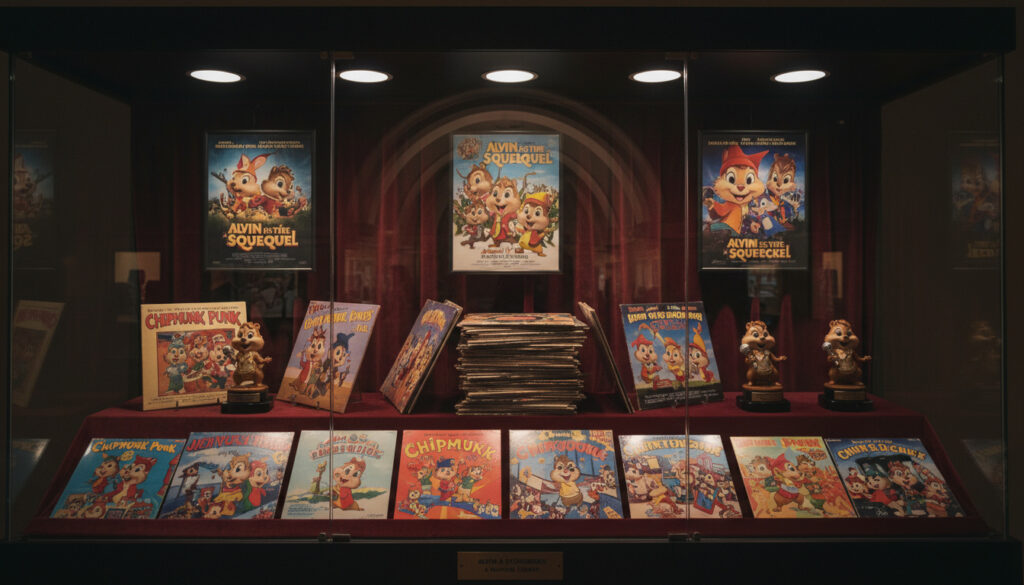
Alvin and the Chipmunks – Complete History, Characters and Movies
Since 1958, the high-pitched harmonies of three animated chipmunk brothers have echoed through American popular culture. Alvin and the Chipmunks, the brainchild of songwriter Ross Bagdasarian Sr., emerged from a novelty recording technique to become a multimedia empire spanning music, television, and film. The franchise centers on the mischievous Alvin, the intellectual Simon, and the gentle Theodore, whose sped-up vocal performances revolutionized novelty entertainment and established a template for family-friendly animated properties.
What began as a single Christmas single transformed into a six-decade phenomenon, surviving the death of its creator, multiple animation revivals, and transitions into live-action cinema. The property remains controlled by Bagdasarian Productions, maintaining family stewardship through two generations while adapting to shifting media landscapes from vinyl records to streaming platforms.
Who Are Alvin and the Chipmunks?
| Created | 1958 by Ross Bagdasarian Sr. |
| Core Characters | Alvin, Simon, Theodore |
| Signature Style | High-pitched voices via speed-up |
| Key Media | TV series (1961-), Movies (2007-2015) |
- Voice innovation originated from analog tape-speed manipulation techniques
- Holiday song origins with “The Chipmunk Song (Christmas Don’t Be Late)”
- Live-action hybrid films achieved significant commercial success in the 2000s
- Family-run franchise maintained through Bagdasarian Productions across generations
- Enduring pop culture icon spanning over sixty years of entertainment history
- Introduction of female counterparts (the Chipettes) expanded narrative possibilities
- Multi-generational appeal through successive animation revivals and format adaptations
| Fact | Detail |
|---|---|
| Creator | Ross Bagdasarian Sr. (David Seville) |
| Debut | 1958 single “The Chipmunk Song” |
| Voice Technique | Tape sped up 3.5x (analog); digital processing (modern) |
| Live-Action Movies | 4 theatrical releases (2007-2015) |
| Current Ownership | Bagdasarian Productions / Paramount Global |
| Brothers | Alvin (leader), Simon (intellect), Theodore (gentle) |
| Female Group | Chipettes: Brittany, Jeanette, Eleanor |
| Human Guardian | Dave Seville |
| Signature Hit | “The Chipmunk Song” (4 weeks #1 Billboard) |
| Awards | 3 Grammys (1958) |
| Total Features | 8 films (1961-2023) |
| Streaming (2025) | Paramount+, Nickelodeon channels |
Who Created Alvin and the Chipmunks and When?
Ross Bagdasarian Sr., performing under the pseudonym David Seville, developed the characters following the commercial success of his 1958 single “Witch Doctor.” According to historical records, Bagdasarian utilized tape-speed manipulation to create high-pitched vocal effects for the earlier track, then refined the technique to develop distinct character voices for three anthropomorphic chipmunk brothers.
The 1958 Breakthrough
The inspiration struck during a visit to Sequoia National Park, where Bagdasarian observed a real chipmunk. This encounter catalyzed the creation of “The Chipmunk Song (Christmas Don’t Be Late),” released in December 1958. Documentation from the franchise confirms the track dominated the Billboard Hot 100 for four consecutive weeks, sold over four million copies, and earned three Grammy Awards, establishing immediate commercial viability for the concept.
The Real Names Behind the Characters
Bagdasarian named the trio after Liberty Records executives who facilitated his recording contract: Alvin honored label president Al Bennett, Simon commemorated co-founder Simon Waronker, and Theodore recognized recording engineer Ted Keep. This nod to industry figures embedded the characters within the historical fabric of American music production.
The signature chipmunk sound originated from recording normal speech at half-speed on analog tape, then playing back at standard speed. This 2:1 ratio effectively raised pitch by one octave. Bagdasarian performed all six original voices (three Chipmunks plus Dave Seville and background vocals) using this method, requiring precise timing to maintain character distinctions during playback.
Who Voices Alvin and the Chipmunks?
The Original Era (1958-1972)
From 1958 until his death in 1972, Ross Bagdasarian Sr. provided every voice for the Chipmunks and their human guardian, Dave Seville. His mastery of the sped-up technique allowed him to create distinct vocal personalities: Alvin’s brash confidence, Simon’s measured intellect, and Theodore’s soft innocence.
The Family Continuation (1979-Present)
Following Bagdasarian’s death, the franchise entered a dormant period until 1979, when television reruns reignited public interest. Bagdasarian Productions, now led by his son Ross Bagdasarian Jr. and daughter-in-law Janice Karman, resumed production. Bagdasarian Jr. assumed vocal duties for Alvin, Simon, and Dave, while Karman voiced Theodore and all three Chipettes, maintaining the audio legacy through family lineage.
The Celebrity Era (2007-2015)
The 2007 live-action/CGI hybrid films marked a departure from family-operated voice work. Justin Long voiced Alvin, Matthew Gray Gubler portrayed Simon, and Jesse McCartney performed as Theodore. Jason Lee appeared as Dave Seville. These productions utilized digital audio processing rather than analog tape manipulation to achieve the high-pitched effect, modernizing the technical approach while preserving the sonic signature.
What Alvin and the Chipmunks Movies and TV Shows Exist?
Television Evolution
The franchise migrated to television in 1961 with The Alvin Show on NBC, running for one season but establishing the visual template for the characters. A more sustained television presence emerged with Alvin and the Chipmunks (1983–1990), produced by Ruby-Spears Enterprises. This iteration introduced the Chipettes and established narrative formats that defined the property for a generation.
A CGI reboot, ALVINNN!!! and the Chipmunks, premiered on Nickelodeon in 2015, running for five seasons. This series modernized character designs while maintaining core personality traits, demonstrating the franchise’s adaptability to contemporary animation standards.
Feature Film Landscape
Theatrical releases began with The Chipmunk Adventure (1987), an animated feature depicting a global balloon race between the Chipmunks and Chipettes. Universal Studios acquired distribution rights in 1996, producing direct-to-video titles including Alvin and the Chipmunks Meet Frankenstein (1999) and Alvin and the Chipmunks Meet the Wolfman (2000).
The live-action/CGI hybrid era commenced in 2007 with Alvin and the Chipmunks, directed by Tim Hill. This film and its three sequels—The Squeakquel (2009), Chipwrecked (2011), and The Road Chip (2015)—collectively generated substantial box office returns, concluding the theatrical run with the 2015 installment.
Brittany, Jeanette, and Eleanor debuted in the 1983 television series as rival performers before evolving into allies and romantic interests for the Chipmunks. In the live-action films, the characters appeared under the management of antagonist Ian Hawke, portrayed by David Cross, adding narrative tension to their integration into the franchise mythology.
As of 2025, specific streaming rights for Alvin and the Chipmunks content vary by platform and region. While Paramount+ carries much of the catalog due to Paramount’s corporate acquisition of franchise rights, availability of specific films and series episodes fluctuates. Viewers should verify current listings on Paramount+, Nickelodeon channels, or rental platforms, as no exclusive 2025 streaming announcements have been confirmed.
How Did the Franchise Timeline Unfold?
- 1958: The Chipmunk Song (Christmas Don’t Be Late) debuts, topping Billboard Hot 100 for four weeks and selling four million copies.
- 1961: The Alvin Show premieres on NBC, marking the first television adaptation.
- 1969: Final original album The Chipmunks Go to the Movies releases before the original run concludes.
- 1972: Ross Bagdasarian Sr. dies; franchise enters hiatus.
- 1979: Television reruns revive audience interest, setting stage for franchise resurrection.
- 1983: New animated series launches, introducing the Chipettes and running through 1990.
- 1987: The Chipmunk Adventure receives theatrical release.
- 1996: Universal Studios acquires distribution rights to the franchise.
- 1999–2000: Direct-to-video features Meet Frankenstein and Meet the Wolfman release.
- 2007: Live-action/CGI hybrid film reboots theatrical presence.
- 2015: Final live-action film The Road Chip and CGI series ALVINNN!!! premiere.
Are Alvin and the Chipmunks Real?
| Established Facts | Information Remaining Unclear |
|---|---|
| The characters are fictional anthropomorphic animals, not real chipmunks. | Specific streaming availability for all titles in 2025 remains variable by region and licensing agreements. |
| Ross Bagdasarian Sr. created the franchise in 1958 using audio manipulation techniques. | No new theatrical film projects have been announced as of 2025. |
| Voice production originally required analog tape speed manipulation; modern productions use digital processing. | Precise viewership data for streaming-era content is not publicly disclosed. |
| Bagdasarian Productions maintains family ownership and creative control. | Future television production schedules beyond existing catalog releases remain unconfirmed. |
What Cultural Impact Have the Chipmunks Made?
The franchise represents one of entertainment’s longest-running continuous properties, spanning over six decades across multiple media transformations. Its influence extends beyond novelty music into animation methodology, demonstrating how audio engineering techniques can define character identity. The transition from analog tape manipulation to digital pitch correction mirrors broader technological shifts in recording industry practices.
Commercially, the Chipmunks achieved multi-platinum record sales and Grammy recognition while maintaining relevance through three distinct cultural eras: the early television age, the 1980s syndication boom, and the 2000s live-action adaptation trend. Similar to how Tony Hawk Pro Skater 3+4 revived legacy gaming properties for contemporary audiences, the Chipmunks franchise has repeatedly resurfaced to engage new generations while retaining core identity elements established in 1958.
The property’s cultural footprint includes participation in landmark television events such as Cartoon All-Stars to the Rescue (1990), an anti-drug special featuring multiple animated franchises. Comic book adaptations ran from 1959 through 1994, further extending the brand’s reach across media formats.
What Do Primary Records Reveal?
The Chipmunk Song dominated the Billboard Hot 100 for four weeks, sold over four million copies, and won three Grammy Awards, launching the franchise.
— Historical documentation regarding the 1958 debut
Brittany, Jeanette, and Eleanor debuted in the 1983 television series as rivals turned allies and romantic interests; in films, managed by antagonist Ian Hawke.
— Franchise archive records
What Defines the Legacy of Alvin and the Chipmunks?
Alvin and the Chipmunks endures as a singular achievement in American entertainment, bridging novelty music, animation, and family cinema across sixty years. From Ross Bagdasarian Sr.’s original tape-speed experiments to modern CGI productions, the franchise maintains continuity through family stewardship and technical adaptation. While no new projects are confirmed for 2025, the property’s catalog remains accessible through Paramount-affiliated platforms, securing its position alongside other revived cultural properties like Spider-Man Brand New Day as a testament to enduring character-driven storytelling.
Frequently Asked Questions
How are the Chipmunk voices technically produced?
Originally, Ross Bagdasarian Sr. recorded speech at half-speed on analog tape, then played it back at standard speed to raise the pitch one octave. Modern productions use digital audio processing to achieve the same high-pitched effect without tape manipulation.
Who are the three Chipettes and when did they appear?
Brittany, Jeanette, and Eleanor are female chipmunk counterparts introduced in the 1983 television series. They initially appeared as rivals to the Chipmunks before becoming allies and romantic interests.
What is the best-selling Chipmunks song?
“The Chipmunk Song (Christmas Don’t Be Late)” remains the best-selling single, topping the Billboard Hot 100 for four weeks in 1958-1959 and selling over four million copies.
Why are they called Alvin, Simon, and Theodore?
Ross Bagdasarian named the characters after Liberty Records executives: Al Bennett (Alvin), Simon Waronker (Simon), and recording engineer Ted Keep (Theodore).
Are new Chipmunks movies planned for 2025?
No new theatrical films or television series have been announced as of 2025. The most recent theatrical release was The Road Chip (2015), though catalog content remains available on streaming platforms.
How many total feature films exist?
The franchise includes eight feature films total: one animated theatrical release (1987), two direct-to-video titles (1999-2000), and four live-action/CGI hybrid films (2007-2015), plus additional specials.
More related posts
 Moderate Snow Ice Warning: Meaning & Met Éireann Criteria
 What Should My Blood Pressure Be? Normal by Age & Gender
 Amazon Fire TV Stick – UK Models Prices and Guide
 Air Force 1 Black – Sizing for Men, Women, Juniors
 Sky TV Contact Number – UK Helplines by Department 2025
 Kate Middleton Fashion Show: True Story of the Sheer Dress
 157 cm in Feet & Inches: Converter, Chart, Height Guide
 Liverpool Christmas Markets 2025 – Dates, Location and Full Guide