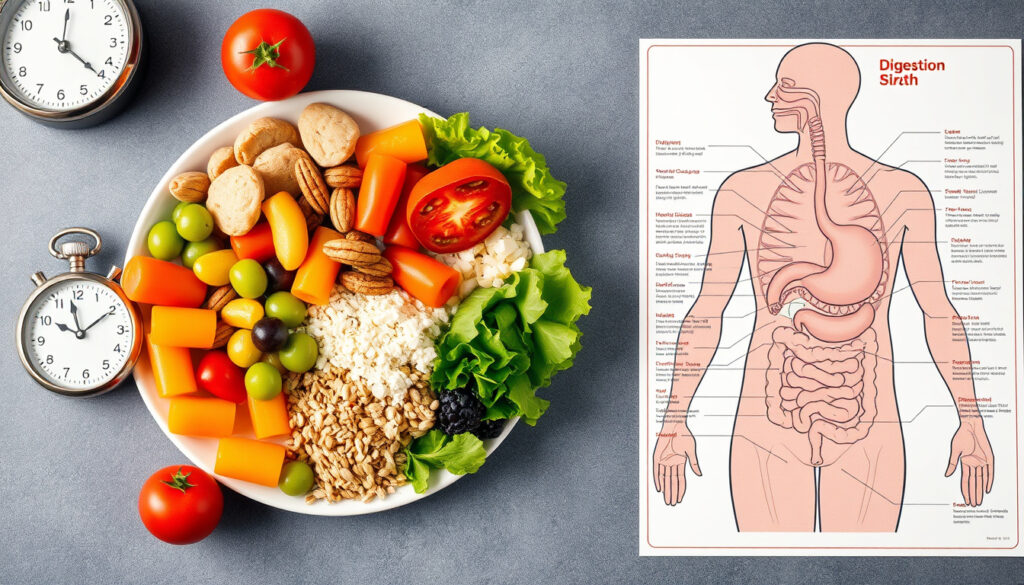
How Long Does It Take to Digest Food? Timeline & Facts
You know that feeling after a big meal — wondering where it all went and how long until your body is done with it. The answer, it turns out, is a surprisingly wide window: most healthy adults take anywhere from 14 to 58 hours to fully process a meal, with an average of 28 hours from first bite to final exit. This guide walks through each stage of that journey, shows how different foods change the clock, and explains why your own time may vary more than you’d expect.
Total digestion time range: 14 to 58 hours (average 28 hours) ·
Stomach emptying time: 40 to 120+ minutes ·
Small intestine transit: 2 to 6 hours ·
Large intestine transit: 12 to 48 hours
Quick snapshot
- Total digestion averages 28 hours (Healthline (health information publisher))
- Stomach empties in 40 to 120+ minutes (IMODIUM UK (consumer health authority))
- Small intestine transit: 2 to 6 hours (Mayo Clinic (leading medical institution))
- Large intestine transit: 12 to 48 hours (Mayo Clinic (leading medical institution))
- Exact effects of vomiting 8 hours after eating depend heavily on individual conditions
- Whether the 20-minute rule meaningfully changes overall transit time
- 0-2 hours: stomach emptying of liquids and simple carbs
- 2-6 hours: small intestine absorbs nutrients
- 6-48 hours: large intestine reabsorbs water
- ~28 hours: average whole-gut transit
- Check specific food types (steak, bread, rice) below for tailored ranges
- Understand how health conditions like gastroparesis or diarrhea shift the clock
- Apply the data to exercise timing and gut health choices
This table captures the key digestion metrics at a glance, showing how each segment contributes to the total timeline.
| Metric | Value |
|---|---|
| Average total transit time | 28 hours (Healthline (health information publisher)) |
| Stomach emptying range | 40 to 120+ minutes (IMODIUM UK (consumer health authority)) |
| Smallest food category (simple carbs) | 30-60 minutes (Healthline (health information publisher)) |
| Largest food category (high fat) | 3-6 hours (Healthline (health information publisher)) |
How long until a meal is fully digested?
The digestive system is a multi-stage relay with each stop running on its own timer. The Mayo Clinic (leading medical institution) puts the total journey through stomach and small intestine at about six hours, then adds up to 36 to 48 hours more for the large intestine. That’s a full day or more before the meal actually leaves your body.
How long does food stay in the stomach?
The stomach is the first major delay point. Cleveland Clinic (Dr. Lee) notes stomach time ranges from 40 to 120-plus minutes depending on what you ate. GoodRx (healthcare information service) widens that to 2 to 5 hours for a full emptying cycle.
- Liquids pass through in 20-40 minutes
- Simple carbs (white rice, bread) leave in 30-60 minutes
- High-fat meals (steak, fried food) can stay 3-6 hours
High-fat meals keep you full longer but slow the whole pipeline. For anyone trying to time digestion before a workout or sleep, that steak dinner is a deliberate choice, not an accident.
How long does it take to digest food and poop it out?
This is the real question most people are asking. Science Learning Hub (educational science resource) estimates whole-gut transit at 24 to 72 hours in healthy adults. Healthline (health information publisher) narrows that to an average of 28 hours, with a range of 14 to 58 hours.
The colon is the bottleneck. Colorado State University (academic physiology resource) estimates colonic transit at 30 to 40 hours after a standard meal — that’s where most of the waiting happens.
The implication: if you ate a meal today, don’t expect to see it tomorrow. Most people won’t eliminate until a day or two later, and that’s perfectly normal.
What foods take 30 minutes to digest?
Not many whole foods are that fast. Simple carbohydrates — think white rice, plain bread, pasta — digest in 30 to 60 minutes according to Healthline (health information publisher). Fruits and most cooked vegetables fall in the same range, around 30 to 60 minutes.
What is the gentlest food on the stomach?
If you’re trying to minimize digestive effort, go for foods that leave the stomach fastest: clear liquids, bananas, white rice, applesauce, and toast — the classic BRAT diet components. These are low in fat and fiber, so they don’t trigger slow gastric emptying.
For someone recovering from an upset stomach or prepping for a morning workout, choosing foods that clear the stomach in under an hour means less chance of cramping or reflux.
What is the 20 minute rule for eating?
The 20-minute rule isn’t about digestion speed — it’s about eating pace. The idea is to take at least 20 minutes per meal so your brain has time to register fullness before you overeat. Ghrelin and leptin signals, which regulate hunger and satiety, take about 20 minutes from stomach stretch receptors to reach the hypothalamus.
Does it affect total digestion time? Indirectly yes. Chewing thoroughly breaks food into smaller particles, which increases surface area for stomach enzymes, and slower eating reduces air swallowing and bloating. But no study has proven that eating slowly itself accelerates gastric emptying.
Why did I throw up food I ate 8 hours ago?
Throwing up food hours after eating is not normal, but it happens. The common medical explanation is gastroparesis — delayed gastric emptying where the stomach muscles don’t contract properly. Food sits in the stomach for hours longer than it should, sometimes triggering vomiting 6-12 hours after a meal.
- Diabetes (especially type 1) is a leading cause of gastroparesis
- GERD and certain medications (opioids, antidepressants) can slow stomach emptying
- Viral infections can temporarily paralyze stomach muscles
Mayo Clinic (leading medical institution) notes that digestion time varies by individual and depends on the kind and amount of food eaten — so the same meal can produce very different outcomes in different people.
How long does it take for food to digest when you have diarrhea?
Diarrhea dramatically speeds up transit. Instead of the usual 12-48 hours in the colon, food can pass through in under 12 hours, sometimes as fast as 4-6 hours. The colon doesn’t have time to reabsorb water, which produces loose stools.
The catch: rapid transit means fewer nutrients are absorbed. For anyone with chronic diarrhea, even high-calorie foods may not deliver their full energy content.
How long after I eat a meal do I poop it out?
Despite the common assumption that you poop what you ate that day, the average delay is 24-48 hours. Mayo Clinic (leading medical institution) says the large intestine alone takes 36 to 48 hours on average.
Four specific foods, four different timelines:
- Bread (simple carbs): exits within 24-48 hours
- Steak (high fat/protein): takes 36-72 hours
- Rice digests in 24-48 hours
- Vegetables (fiber): digest in 24-36 hours
Healthline (health information publisher) notes that some research suggests food may take up to 5.5 days to fully digest, especially if the meal was very high in fat or fiber combined with other slow-transit factors.
What this means: if you ate steak for dinner on Monday, don’t be surprised if traces don’t exit until Thursday. That’s not a problem — it’s biology.
What are the 6 worst foods for gut health?
Some foods slow digestion, inflame the gut lining, or feed harmful bacteria. Here are the most common offenders, based on gastrointestinal research:
- Processed meats (bacon, sausage) — high in saturated fat and preservatives that slow gastric emptying
- Fried foods — take 3-6 hours in the stomach and trigger reflux
- Artificial sweeteners (sorbitol, sucralose) — can accelerate transit and cause diarrhea
- High-fructose corn syrup — linked to gut inflammation and bacterial overgrowth
- Alcohol — irritates the stomach lining and delays stomach emptying
- Dairy (for lactose intolerant individuals) — causes cramping, bloating, and rapid transit
A high-fiber vegetable is great for long-term gut health but slows transit in the short term. The “worst” foods for gut health by one measure (speed) may be fine by another (microbiome diversity). The trade-off depends on what you’re trying to optimize.
What meal is best to skip?
For digestion timing, the most disruptive meal to skip is a large late dinner. Eating a heavy meal within 3 hours of lying down increases acid reflux risk and delays stomach emptying overnight. Healthline (health information publisher) lists dietary habits and underlying health conditions as factors affecting transit time — and meal timing is one of the most controllable habits.
If you must skip a meal, make it the evening one, not breakfast. Skipping breakfast may disrupt the gut microbiome’s circadian rhythm, while skipping a late meal improves sleep quality and reduces reflux.
“Food takes about six hours on average to move through the stomach and small intestine. The remainder of the process through the large intestine may take up to 36 to 48 hours on average.”
— Mayo Clinic (leading medical institution)
“Total emptying of the stomach occurs at about 4 to 5 hours in healthy humans after a standard mixed meal. Transit through the colon is estimated at 30 to 40 hours.”
“Gastric emptying can range from zero to six hours, small-intestinal transit from two to eight hours, and colonic transit varies widely by colon segment.”
— Healthline (health information publisher)
The data is consistent: the stomach is the gatekeeper, the small intestine is the express lane, and the colon is where patience pays off. For anyone wondering how long does it take to digest food, the honest answer is “between half a day and three days, depending on what you ate and who you are.” That variability isn’t a glitch — it’s the digestive system doing its job, adjusting the schedule for every meal.
Timeline: Food’s journey from mouth to toilet
- 0-2 hours: Stomach empties partially — initial digestion of liquids and simple carbs
- 2-6 hours: Food moves through small intestine — nutrients absorbed
- 6-48 hours: Enter large intestine — water reabsorption, eventual elimination
- ~28 hours: Average total transit time (mouth to toilet)
Understanding how long it takes to digest food can also help contextualize the food poisoning recovery timeline, as both involve the gastrointestinal system’s response to different challenges.
Frequently asked questions
Do liquids digest faster than solid food?
Yes. Clear liquids can leave the stomach in 20-40 minutes, while solid foods take 40 to 120+ minutes to empty into the small intestine (IMODIUM UK (consumer health authority)).
Can stress affect digestion time?
Yes. Stress activates the sympathetic nervous system, which slows gastric emptying and can either accelerate or delay colonic transit. Healthline (health information publisher) lists stress as a factor affecting transit time.
How does fiber impact digestion speed?
Soluble fiber slows gastric emptying by forming a gel, while insoluble fiber speeds colonic transit. Both types are essential, but the net effect depends on the balance (Healthline (health information publisher)).
Does age affect how long digestion takes?
Yes. Gastric emptying and colonic transit tend to slow with age due to reduced muscle tone and nerve signaling. GoodRx (healthcare information service) notes age as a factor in transit variation.
Can exercise speed up digestion?
Moderate exercise can speed gastric emptying by stimulating blood flow and gut motility. Intense exercise, however, can temporarily delay digestion by diverting blood to muscles.
Does pregnancy change digestion time?
Yes. Progesterone relaxes smooth muscle, slowing gastric emptying and colonic transit. Many pregnant women experience prolonged digestion and constipation as a result.
What is gastroparesis and how does it affect digestion?
Gastroparesis is delayed gastric emptying without a physical blockage. Food sits in the stomach for 6-12 hours or more, often causing nausea, vomiting, and bloating. Mayo Clinic (leading medical institution) identifies diabetes as a common cause.
More related posts
 Can Dogs Have Popcorn? Safety Guide from AKC & Purina
 18 Stone in Lbs – Exact Conversion Guide and Charts
 Rachel Reeves Cash ISAs: New £12,000 Limit Explained
 Animal Beginning With U – Rare Species List, Facts and Habitats
 The Chronicles of Narnia: Book order, bans and 2026 Netflix film
 The Running Man 2025: Good Movie? Reviews & Where to Watch
 What Is the Name for Energy Transferred per Second by Appliances?
 Playing Games Blog PlayBattleSquare: Verified Facts & Guide