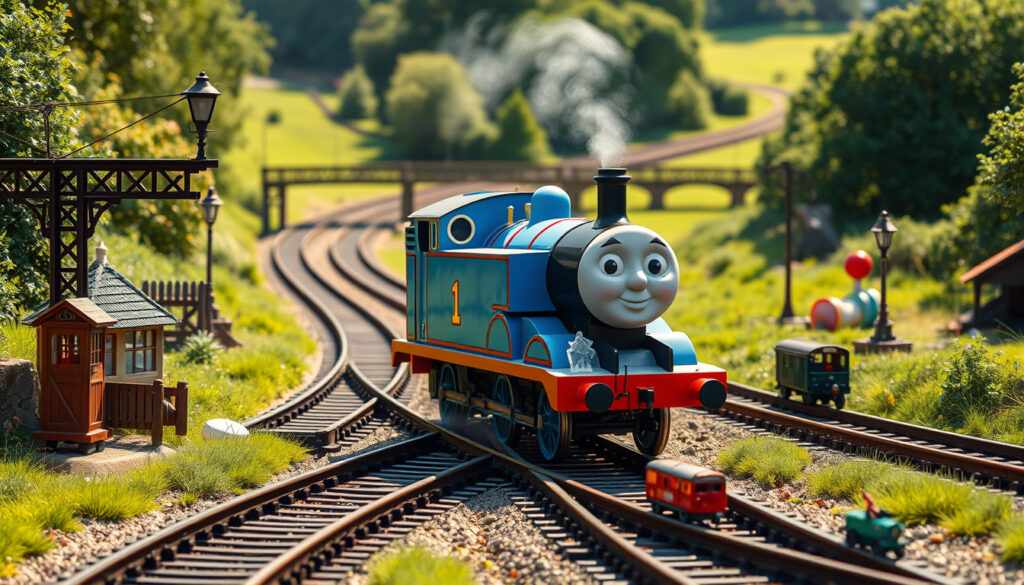
Thomas the Tank Engine – Guide to Characters, History and Toys
Thomas the Tank Engine: A Complete Guide to the Iconic Locomotive
Thomas the Tank Engine stands as one of the most recognizable fictional locomotives in global popular culture. The blue tank engine, created by Reverend Wilbert Awdry in the mid-1940s, has evolved from a simple wooden toy into the centerpiece of a multi-platform franchise spanning books, television, toys, and digital media. Operating on the fictional Island of Sodor, Thomas has transported generations of children through stories of friendship, teamwork, and adventure aboard the North Western Railway.
The character first appeared in print in 1946, marking the beginning of what would become The Railway Series—a collection of books written by Awdry for his young son Christopher. Britt Allcroft later adapted these stories into television, transforming Thomas into the titular star of a series that would air continuously for over four decades. Today, Mattel holds the rights to the franchise, overseeing everything from television production to toy manufacturing, maintaining Thomas’s presence in living rooms around the world.
This guide examines the origins, characters, merchandise, and cultural phenomena surrounding the iconic engine, separating established facts from internet rumors and exploring what makes Thomas enduringly popular across multiple generations of audiences.
What are the main Thomas the Tank Engine characters?
Thomas serves as the number one engine of the North Western Railway, but the fictional world of Sodor contains a rich cast of locomotives, each with distinct personalities that drive the storytelling. Understanding these characters requires examining their roles within both the original books and the expanded television universe.
The core engines of the Railway Series
The first book, The Three Railway Engines (1945), introduced three engines before Thomas made his debut. Edward appeared first, created by Awdry when his son requested more stories featuring a train named “Edward.” Gordon followed as a large express engine, while Henry came with a complex backstory involving a collapsed tunnel. These three engines established the narrative formula that would define the series—personality-driven stories centered on railway operations.
Thomas debuted in his own volume the following year, described as a “fussy” and “cheeky” engine with six small wheels, a short stumpy funnel, and a distinctive boiler and dome. His introduction story involved rescuing James after a crash, earning him his own branch line and cementing his role as the series protagonist.
Supporting characters and their roles
The television adaptation expanded the cast significantly, introducing characters from subsequent Railway Series books. James, a red tender engine rescued by Thomas in his debut story, became a recurring character whose crashes and mishaps frequently drove plot development. Percy, a small green tank engine, served as Thomas’s close friend and often his companion in adventures.
Toby, a brown tram engine based on real Great Western locomotives, joined the cast in the television series, bringing expertise in handling horses and operating on branch lines. The narrow-gauge engines of the Skarloey Railway, including Skarloey himself, Sir Handel, and Peter Sam, represented smaller locomotives working under Mr. Percival, the Thin Controller.
The Arlesdale Railway introduced miniature engines Mike, Rex, and Bert, operated by Mr. Fergus Duncan, known as the Small Controller. Tidmouth Sheds serves as the central location where most main engines reside, notable as the only location appearing in every television season.
Gordon, Henry, and Edward originated in The Three Railway Engines (1945), while Thomas first appeared in the 1946 book Thomas the Tank Engine. James’s introduction also came in 1946, following the crash that defined his early relationship with Thomas. These four engines form the core cast of the original Railway Series.
Controllers and authority figures
The engines operate under human controllers rather than traditional conductors. The Fat Controller, formally known as Sir Topham Hatt, serves as the chief administrator of the North Western Railway, overseeing operations and discipline. His wife, the Lady Hatt, appears in various stories, while the Thin Controller manages the Skarloey Railway and the Small Controller handles the Arlesdale Railway.
This hierarchical structure distinguishes Sodor from real railways and establishes clear authority figures who shape engine behavior through praise, criticism, and assignment of tasks. The relationship between engines and their controllers forms a key narrative element, teaching children about respecting authority while also showing engines earning trust through demonstrated reliability.
What is the history of Thomas the Tank Engine?
The origins of Thomas the Tank Engine trace to 1942, when Reverend Wilbert Awdry constructed a wooden toy train for his two-year-old son Christopher. The toy featured a freelance locomotive design with elongated side tanks, representing water and coal storage—a defining characteristic of tank engines. Awdry, inspired by real LB&SCR E2 class 0-6-0 tank engines from the London, Brighton and South Coast Railway, incorporated these design elements into his fictional creation.
Formalizing the character’s backstory required several years of development. Awdry drew inspiration from actual railway engines he had observed, eventually establishing Thomas as an E2-class engine originating from Brighton in the fictional chronology. Early illustrations and the wooden toy itself bore closer resemblance to a J50 locomotive, demonstrating the organic evolution of the character’s design.
From books to television
The Railway Series expanded considerably between 1945 and the early 1970s, with Reverend Awdry writing twenty-six books and his son Christopher contributing additional volumes. The books sold remarkably well, with The Three Railway Engines moving over 55,000 copies in its first year alone. This commercial success attracted the attention of producer Britt Allcroft, who recognized the potential for television adaptation.
In 1979, Allcroft acquired the rights to The Railway Series and began developing the television series Thomas the Tank Engine & Friends, which later shortened to Thomas & Friends. The adaptation made Thomas the central protagonist, elevating him from one of several main characters to the undisputed star. The series launched in 1984, combining live-action model sequences with voice narration, establishing a format that would continue for decades.
Christopher Awdry served as a consultant during the early seasons, helping maintain consistency with the books while allowing the television adaptation to develop its own direction. The relationship between book canon and television adaptation created two overlapping but distinct continuities that fans continue to navigate.
Global expansion and franchise development
The franchise expanded internationally throughout the 1990s and 2000s. Japan welcomed Thomas in 1991, and subsequent years saw localization efforts across numerous markets. Mattel’s acquisition of the franchise consolidated toy production and television distribution under a single corporate entity, enabling coordinated marketing across platforms.
The franchise accumulated notable achievements during this expansion. A Guinness World Record recognized the Largest Model Railway Engine—a 264.3 centimeter representation of James constructed during a 2002 tour. Full-scale replicas of Thomas himself required two days to construct and could steam for approximately 2.5 hours during operational demonstrations.
A full-scale working replica of Thomas the Tank Engine was constructed for promotional tours. Building the replica required two days of assembly, and the engine could operate independently, steaming for approximately two and a half hours during public demonstrations.
What Thomas the Tank Engine toys and games are available?
The Thomas the Tank Engine franchise has generated an extensive range of merchandise spanning multiple decades and product categories. From wooden railway sets to digital applications, the brand maintains a presence across retail channels worldwide.
Wooden railway systems
The wooden railway system represents the flagship product line, originating from the original production partnership between the Awdry family and the British manufacturer that first produced wooden trains under license. These sets feature wooden track pieces, plastic connectors, and detailed locomotive models that have become synonymous with the brand. Children and collectors alike value the tactile quality and durability of these systems, which encourage imaginative play scenarios based on the television series and books.
Collectible merchandise
Beyond complete railway sets, the franchise produces individual engines, rolling stock, and track accessories available separately. These products range from budget-friendly options suitable for young children to premium collectible versions featuring enhanced detailing and limited-edition paint schemes. Annual releases typically coincide with new television seasons, introducing characters and scenarios that reflect current storylines while maintaining compatibility with existing collections.
Digital games and applications
The digital presence includes mobile applications, console games, and online platforms that extend the Thomas experience beyond physical toys. These range from simple puzzle games for younger children to more complex railway simulation experiences. Interactive apps often incorporate voice clips and music from the television series, creating familiarity across both physical and digital play environments. You can find more information about the official Thomas & Friends website for current digital offerings and age recommendations.
Product recommendations vary by category. Wooden railway systems typically suit children aged 2 and older, while more complex digital games may target ages 5 through 10. Always check packaging for specific age guidance and safety information.
Why has Thomas the Tank Engine remained popular?
The enduring appeal of Thomas the Tank Engine stems from several interconnected factors that have evolved alongside changes in media consumption and childhood expectations. Understanding these elements provides insight into the franchise’s remarkable longevity.
The characters embody relatable personality traits that resonate with young audiences. Each engine exhibits flaws and virtues that mirror human characteristics—Gordon’s pride, Thomas’s eagerness, Percy’s loyalty—creating emotional connections that transcend the mechanical nature of the subjects. This anthropomorphism allows children to explore complex social situations through a safe, non-threatening lens where lessons emerge naturally from narrative consequences rather than direct instruction.
The Railway Series books, preserved in their original form alongside the television adaptation, provide a foundation of quality storytelling that has earned praise from parents and educators. The literary merit of Awdry’s work contributes to the franchise’s credibility beyond simple entertainment, with academic discussions of the books appearing in educational publications.
Educational value
Educational researchers have examined the pedagogical potential of the series, identifying opportunities for teaching concepts ranging from basic counting and vocabulary to more sophisticated ideas about friendship, cooperation, and consequence. The concrete nature of railways—trains that move along tracks, carry cargo, and arrive at destinations—provides a framework for understanding abstract concepts through tangible examples.
Teachers and childcare professionals have incorporated Thomas materials into classroom activities, leveraging children’s existing familiarity with the brand to facilitate learning objectives. The visual language of the television series, with its clear character identification through color and shape, supports early childhood development in ways that extend beyond entertainment.
Generational continuity
Parents who grew up with Thomas often introduce the franchise to their children, creating cyclical engagement that reinforces brand loyalty across generations. This intergenerational appeal distinguishes Thomas from properties that rely primarily on current marketing appeal, instead drawing strength from nostalgic attachment and shared family experiences.
The availability of classic episodes alongside contemporary content allows families to share earlier seasons with younger viewers, creating common reference points that facilitate intergenerational dialogue. Archives and home video collections have preserved this content accessibility despite changes in distribution platforms over the years.
Frequently Asked Questions
Who created Thomas the Tank Engine?
Reverend Wilbert Awdry created Thomas the Tank Engine in 1942 as a wooden toy for his son Christopher. He later developed the character into the Railway Series books beginning in 1945, with the first Thomas story appearing in 1946.
How many books are in the Railway Series?
Reverend Awdry wrote twenty-six books in the original Railway Series, with his son Christopher contributing additional volumes after Awdry concluded his writing. The complete collection spans the fictional history of the North Western Railway and its various branch lines.
What year did the television series first air?
The television adaptation premiered in 1984, produced by Britt Allcroft Productions. The series initially aired under the title “Thomas the Tank Engine & Friends” before later shortening to “Thomas & Friends” for its international broadcasts.
Who owns the Thomas the Tank Engine franchise?
Mattel acquired the Thomas the Tank Engine franchise and currently holds the rights to all aspects of the brand, including television production, toy manufacturing, and digital media distribution.
Where is the fictional Island of Sodor located?
The Island of Sodor exists as a fictional location in the stories, situated between the mainland and the Isle of Man in the Irish Sea. While inspired by real British railway geography, the island and its railway system are entirely products of Awdry’s imagination.
More related posts
 Spire Healthcare Share Price – Latest Levels, Chart and Analysis
 What’s Love Got to Do with It: Tina Turner’s Iconic Song and Biopic
 Class 2 National Insurance – Guide for Self-Employed 2025
 Royal Holloway University of London Ranking – UK 35th, QS 461st Analysis
 How Much Is YouTube Premium UK – Prices and Plans 2024
 Range Rover Sport for Sale in Ireland: Prices & Listings
 Protest in London Today – Massive Anti-Far-Right March
 Real Madrid vs Atlético Madrid Lineups – Confirmed XI, Team News