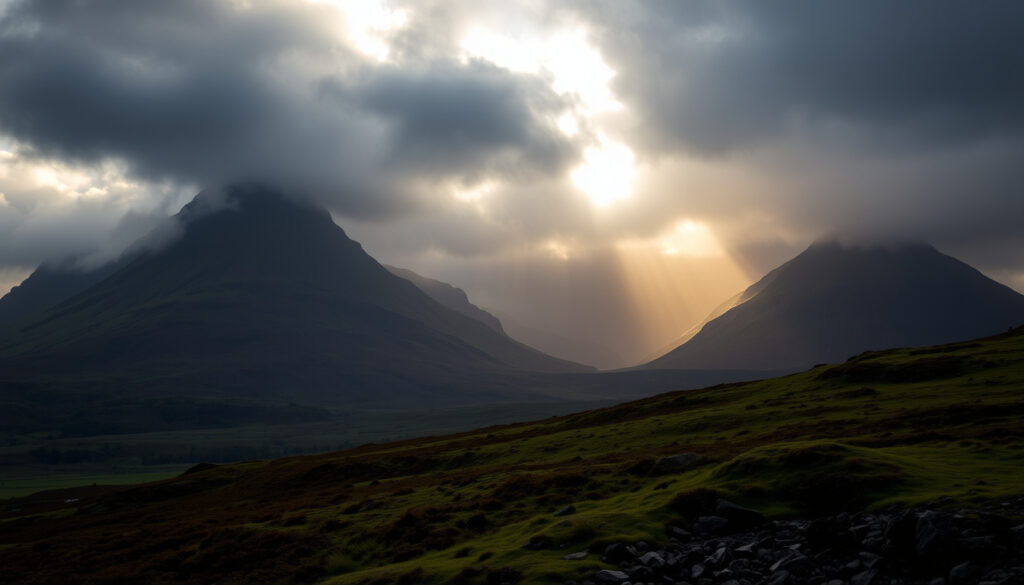
Isle of Skye Weather: Month-by-Month Guide, Forecast & Tips
There’s a reason the Isle of Skye draws visitors year after year, but the weather can make or break the trip. With an annual average of 200 rainy days and temperatures that rarely top 18°C, the key to a great Skye experience lies in knowing what to expect and when to go. This guide breaks down the island’s climate month by month, helps you dodge the midges, and tells you how to read the forecasts before you set out.
Average summer high: 15°C ·
Average winter low: 2°C ·
Annual rainfall: 2000 mm ·
Sunniest month: May ·
Midge season peak: June–July
Quick snapshot
- The Gulf Stream moderates temperatures, preventing extreme cold (Isle of Skye tourism guide)
- Midges appear when temperatures exceed 10°C and humidity is high (Isle of Skye tourism guide)
- Exact timing of the first autumn storm each year (Isle of Skye tourism guide)
- Whether climate change will shift midge season length (Weather Spark climate data)
- May–June: longest daylight, fewer midges (Isle of Skye tourism guide)
- July–August: warmest but midge peak (Weather Spark climate data)
- September: quieter, still mild (Isle of Skye tourism guide)
- October: wettest month (Holiday Weather averages)
- Check 10-day forecast on Met Office (UK’s national weather service) before travel
- Pack layers and waterproofs — conditions change rapidly (Isle of Skye tourism guide)
| Metric | Value |
|---|---|
| Highest recorded temperature | 27°C |
| Lowest recorded temperature | -10°C |
| Average annual sunny hours | 1,200 |
| Average number of rainy days | 200 |
The pattern in these records is clear: Skye’s climate is damp and temperate, with no extreme highs or lows.
What is the best month to visit the Isle of Skye?
The answer depends on what you value most — daylight, warmth, dryness, or solitude. No month is perfect, but a few stand out.
Best for sunshine
- May and June offer the most daylight — up to 18 hours of usable light in late June. The sky is clearest in May, with 45% partly sunny conditions (Weather Spark climate data).
- July is the warmest month, averaging 15.5°C, but clouds increase (Weather Spark climate data).
Best for avoiding crowds
- Late April and early May see moderate visitor numbers before the summer rush.
- September has mild weather (averages 13°C) and significantly fewer tourists than August (Isle of Skye tourism guide).
Best for hiking
- May and June — combination of long days, lower rainfall (around 50 mm less than October) and fewer midges (Holiday Weather averages).
- Mid-August to early September also work if you tolerate insects.
The implication: the best month depends entirely on your personal trade-off between warmth, crowds, and pests.
Is it cold in the Isle of Skye?
Short answer: not in an Arctic sense, but it rarely feels warm. The Gulf Stream keeps winter lows around 2°C, and summer highs struggle past 18°C (Weather Spark climate data).
Average temperatures by season
- Winter (Dec-Feb): average high 7°C, low 2°C.
- Spring (Mar-May): highs from 8°C to 13°C.
- Summer (Jun-Aug): highs 14°C–18°C, lows 9°C–12°C (Weather Spark climate data).
- Autumn (Sep-Nov): highs drop from 14°C to 8°C.
Wind chill factor
The island’s exposure to Atlantic winds often makes the air feel 3–5°C colder than the thermometer reads (Isle of Skye tourism guide). A 12°C day with 30 mph gusts feels like 8°C.
Packing tips
- Base layers, fleece, waterproof jacket, and sturdy boots year-round.
- In summer, add a light fleece and rain cover; in winter, thermal-lined gloves and a hat.
Even in August, a sunny morning can turn into a cold, foggy afternoon. The island’s nickname — “Misty Isle” — comes from the coastal fog called haar that rolls in without warning (Isle of Skye tourism guide).
What this means: the felt temperature matters more than the number on the thermometer.
Are midges bad on the Isle of Skye?
Midges are the bane of many Skye trips. They’re tiny biting flies that swarm in warm, damp, still air.
Midge season
- Peak: June to August, especially July (Isle of Skye tourism guide).
- Activity drops sharply when temperature falls below 10°C or wind exceeds 10 mph.
How to avoid midges
- Use repellents containing DEET or Picaridin.
- Cover skin: long sleeves, trousers, and a hat with a net.
- Aim for exposed, breezy spots — midges hate wind.
- Avoid twilight hours near water and heathland.
Best times to visit if you hate midges
- Early May (before the first hatch) and September (after the peak) are far more comfortable.
- Winter months are completely midge-free but cold.
If climate change extends the warm, humid window, midge season could start earlier and last later. For now, late May and early September are your safest bets to avoid being eaten alive (Isle of Skye tourism guide).
The pattern: the worst midge months align with the warmest weather, forcing visitors to choose between comfort and solitude.
What is the Isle of Skye weather by month?
Each month offers a distinct trade-off. The table below shows averages for temperature, rainfall, and daylight hours, followed by month-by-month notes.
| Month | Avg high (°C) | Avg low (°C) | Rainfall (mm) | Daylight hours | Notes |
|---|---|---|---|---|---|
| Jan | 7 | 2 | 140 | 7.5 | Cold, storms possible |
| Feb | 6 | 1 | 120 | 9 | Coldest month |
| Mar | 8 | 3 | 110 | 12 | Spring begins |
| Apr | 10 | 4 | 70 | 15 | Drier, clearer |
| May | 13 | 7 | 60 | 17 | Sunniest, lowest rain |
| Jun | 15 | 9 | 75 | 18 | Longest days |
| Jul | 16 | 11 | 95 | 17 | Warmest, midge peak |
| Aug | 16 | 11 | 105 | 15 | Warm, high season |
| Sep | 14 | 9 | 110 | 13 | Mild, fewer crowds |
| Oct | 11 | 7 | 150 | 10.5 | Wettest month |
| Nov | 9 | 4 | 130 | 8 | Autumn storms |
| Dec | 7 | 2 | 140 | 7 | Shortest days |
Sources: Weather Spark climate data and Holiday Weather averages.
The pattern: spring (April–May) is the sweet spot — lower rainfall and more sun. Autumn (September–October) offers mild weather but increasing rain. Winter is dark and wet but free of crowds and midges.
The takeaway: there is no perfect month, only a season that aligns with your priorities.
What is the 10-day weather forecast for Isle of Skye?
Because Skye’s weather changes hour by hour, a 10-day forecast should be treated as a trend, not a guarantee.
How to interpret the forecast
- Look at wind speed and direction — strong southwesterlies often bring rain.
- Check the “feels like” temperature (wind chill can drop it 3–5°C).
- Focus on the first 3–5 days for accuracy; beyond that, expect shifts.
Where to get reliable forecasts
- Met Office — the UK’s national weather service, offers hourly forecasts and mountain-specific reports (Met Office (UK’s official weather authority)).
- BBC Weather — user-friendly and updated regularly (BBC Weather (public service broadcaster)).
- AccuWeather — provides minute-by-minute precipitation forecasts.
Tips for checking ahead
- Check for Moderate Snow Ice Warning: Meaning & Met Éireann Criteria if travelling in winter — these warnings can affect road access.
- Always carry waterproofs regardless of the forecast — conditions flip rapidly on the coast.
The Met Office’s ‘mountain weather’ service is tailor-made for Skye hikers. It gives wind speed, visibility, and freezing level — far more useful than a generic town forecast (Met Office mountain forecast).
The pattern: short-term forecasts are reliable, but long-range predictions are best treated as probabilities, not certainties.
What is the weather in Portree, Isle of Skye?
Portree, the island’s main town, enjoys a slightly sheltered microclimate compared to the exposed western coastline and the Cuillin ridge.
Portree microclimate
- Lying in a natural bay, Portree is protected from the full force of Atlantic westerlies.
- Temperatures are often 1–2°C warmer than in the open hills.
- Rainfall is typically 10–15% lower than on the west coast (Isle of Skye tourism guide).
Comparison to other parts of Skye
- The Cuillin mountains experience their own mountain weather — colder, windier, and with sudden cloud cover.
- The west coast around Dunvegan gets more rain and stronger winds.
- The eastern side (Portree, Broadford) tends to be drier and milder.
Portree weather for travelers
- Portree is often the best base for a trip because its harbour shelters from the worst gusts.
- Even on a rainy day, the town has indoor activities (pubs, galleries) and the views can clear quickly.
For a live Portree forecast, check BBC Weather (Portree).
Confirmed facts vs. what remains unclear
After sifting through the data, some things are certain, while others still carry uncertainty.
Confirmed facts
- The Gulf Stream prevents extreme cold, keeping winter lows above -10°C (Isle of Skye tourism guide)
- Midges appear when temperature >10°C and humidity is high (Isle of Skye tourism guide)
- October is the wettest month on average (Holiday Weather)
- May is the sunniest month (Weather Spark)
What’s unclear
- Exact timing of first autumn storm each year (Isle of Skye tourism guide)
- Whether climate change will shift midge season length (Weather Spark)
- Long-term impact of changing Gulf Stream strength on Skye’s temperature range (Met Office)
Expert and local perspectives
The Isle of Skye is one of the most weather-variable places in the UK. A forecast can be spot on for two days and then completely different by day three. That’s why we recommend checking the mountain weather forecast before any hillwalking trip — it includes wind speed, visibility, and freezing level information that standard forecasts miss.
– Met Office (UK’s national weather service)
If you want to see Skye at its best, aim for late May or early June. The days are long, the hills are green, and you have a decent chance of avoiding the midges. Even then, pack a good waterproof jacket — you’ll almost certainly need it at some point.
– VisitScotland (Scotland’s official tourism body)
For travellers planning a trip to the Isle of Skye, the trade-off is clear: choose between warmth (July) and comfort (May/September). If midges are the dealbreaker, avoid June–August. If you value solitude and don’t mind rain, October’s deep colours are spectacular. The best strategy, however, is to book flexible accommodation and check the Met Office’s 5-day forecast a week before you go — and then pack for all four seasons in one day.
travelscoop.co.uk, adventures-scotland.com, kupi.com, metoffice.gov.uk
Frequently asked questions
Does it snow on the Isle of Skye?
Yes, but rarely heavily. Snowfall is most likely in January and February, especially on higher ground like the Cuillin ridge. Low-lying areas may see a dusting a few times a year. Snow rarely stays long (Isle of Skye tourism guide).
What is the best time for hiking on Skye?
Late May to early June offers the best combination of long daylight, mild temperatures, and fewer midges. September is also good for walkers who prefer cooler conditions (VisitScotland (Scotland’s official tourism body)).
How strong are the winds on Skye?
Exposed areas, especially the west coast and Cuillin, can see gusts over 60 mph during autumn and winter storms. Average wind speed is around 15 mph, but it picks up significantly in October–February (Weather Spark).
What is the UV index like in summer?
Even on overcast days, UV can be moderate (index 4–6) in June and July due to the high latitude. Sunscreen is recommended for long days outdoors.
When is the driest month on Skye?
May is typically the driest, with an average of 60 mm of rain. April and June are also relatively dry (Holiday Weather).
What clothing should I bring for a trip to Skye?
Layers are essential: base layer, fleece, waterproof jacket, and waterproof trousers. Sturdy waterproof boots are a must for hiking. In winter, add a warm hat, gloves, and a thermal base layer.
Are there any weather warnings I should watch for?
Yes. The Met Office issues yellow and amber warnings for wind, rain, and snow. Winter warnings can impact roads — check the Moderate Snow Ice Warning guide for details on what the alert levels mean.
More related posts
 Men’s North Face Jacket Guide: Types, Features & Best Picks
 Happiest Country in the World – Finland Tops Report
 Playing Games Blog PlayBattleSquare: Verified Facts & Guide
 How to Get Rid of Gum Disease – Stages and Proven Treatments
 West Ham vs Sunderland AFC Standings: Head-to-Head & Predictions
 Lee Min-ho – Age, Dramas, Military Service and Bio
 Pablo Escobar Death: Cause, Shooter, and Aftermath for Family
 Norwich City vs Southampton: H2H, Prediction, Lineups