What Do You Meme – How to Play the Meme Caption Game
What Do You Meme? The Internet’s Favorite Party Game
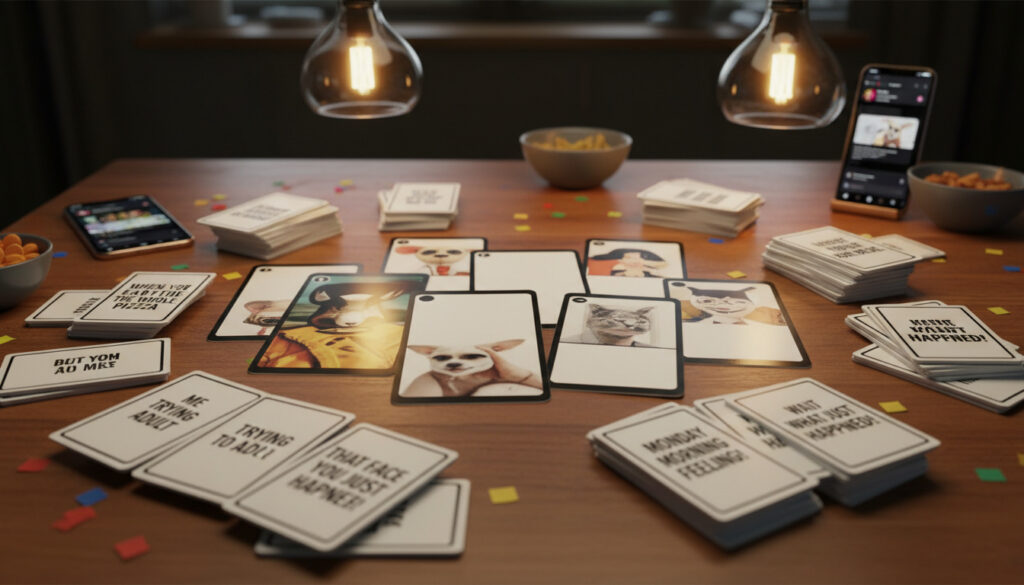
What Do You Meme? emerged in 2016 as a visual alternative to text-based party games, combining internet culture with analog gameplay. Created by the social media collective Fuckjerry, the game translates the endless scroll of meme culture into a competitive format where players match caption cards to viral photo cards. Unlike traditional adult party games that rely solely on wordplay, this game leverages the shared visual language of social media to generate humor through juxtaposition rather than scripted jokes.
Core Components and Specifications
Card Library
Each box contains 360 caption cards and 75 photo cards featuring classic internet imagery printed on casino-quality stock.
Scalability
Accommodates 3 to 20+ participants, making it adaptable for intimate gatherings or larger parties without mechanical degradation.
Content Rating
Marketed strictly for ages 17 and above due to mature themes, explicit language, and culturally sensitive humor.
Market Position and Cultural Impact
The game’s success reflects a broader shift in entertainment toward participatory internet culture. By commercializing the meme format—which traditionally thrives on organic, user-generated content—What Do You Meme? created a licensed pipeline for intellectual property that typically circulates freely online. This approach has generated significant revenue while navigating the complex copyright landscape of viral imagery, establishing a precedent for how digital ephemera can be monetized through physical products.
Competitive Landscape
| Feature | What Do You Meme? | Cards Against Humanity | Exploding Kittens |
|---|---|---|---|
| Primary Mechanic | Image-caption matching | Fill-in-the-blank text | Russian roulette card draw |
| Content Style | Visual memes + text | Shock humor text | Strategic avoidance |
| Player Count | 3-20+ | 4-30+ | 2-5 |
| Expansion Model | Themed packs (Basic Bitch, Game of Thrones) | Periodically updated decks | Expansion packs |
Mechanics and Gameplay
Gameplay operates through a rotating judge system. Each round, one player draws a photo card displaying a viral image while others submit caption cards from their hands. The judge selects the pairing that best captures the humor of the image, awarding a point to the winning player. This card matching mechanic creates emergent comedy through unexpected combinations rather than relying on player improvisation.
The physical components use high-resolution printing to preserve the nuances of original memes, while the box design facilitates rapid setup and teardown. Unlike traditional strategy games, victory depends on understanding the subjective humor preferences of the current judge rather than mathematical optimization.
Development and Release Timeline
- : Launches on Kickstarter, raising over $150,000 against a $10,000 goal.
- : Fulfillment of backer rewards and initial retail release through direct-to-consumer channels.
- : Release of first expansion packs including the “Basic Bitch” pack and “Stoner” pack, targeting specific subcultures.
- : Partnership announced with Spin Master for expanded distribution into major retail chains.
- : Launch of licensed editions including Game of Thrones and Real Housewives collaborations.
- : Introduction of family-friendly spin-off “What Do You Meme? Family Edition” to capture adjacent markets.
Strategic Considerations
New players often conflate the game with simple “caption contests,” but the competitive element introduces nuanced strategy. Holding cards with versatile phrases—those applicable to multiple emotional contexts—provides advantage over highly specific captions. The judging criteria remains entirely subjective, dependent on the humor preferences of the current round’s judge, similar to Apples to Apples but utilizing visual rather than textual prompts.
Design Philosophy and Sustainability
The design succeeds by externalizing creativity. Where improvisational comedy games demand spontaneous wit from players, What Do You Meme? provides pre-written humor, reducing performance anxiety. This accessibility broadens the demographic beyond natural comedians to casual participants seeking structured social interaction.
However, the game faces content sustainability challenges intrinsic to its concept. Meme culture evolves rapidly; a card featuring a 2016 viral reference may confuse or bore players by 2024. The company addresses this through constant expansion packs, creating a collectible model that maintains relevance but increases long-term costs for consumers. According to documentation of the game’s development, this iterative content model was intentional, ensuring recurring revenue through novelty rather than evergreen mechanics.
Critical Reception
“It captures the specific absurdity of browsing Twitter at 2 AM, but transforms that passive consumption into active social engagement.”
— Wirecutter Review, 2023
“The production quality elevates it beyond typical novelty gifts, though the humor remains firmly in the gutter.”
Verdict
What Do You Meme? established itself as a staple of modern adult entertainment by translating digital culture into physical form. While dependent on the ephemeral nature of internet trends, the game’s robust mechanical foundation and aggressive expansion strategy have secured its position alongside established party game franchises. For groups seeking structured social interaction without creative pressure, it offers a reliable, if occasionally dated, comedy experience grounded in shared digital literacy.
Frequently Asked Questions
Is What Do You Meme? appropriate for family gatherings?
The base game contains explicit content and references suitable only for adults. However, the company released a Family Edition in 2021, filtering images and captions for ages 8 and up.
How does this differ from other meme-based games?
Unlike derivative games that simply collect existing memes, What Do You Meme? licenses specific viral images and pairs them with original caption content, creating a curated gameplay experience rather than a simple viewing activity.
Can you play with fewer than three people?
The mechanics require a minimum of three players to function properly—one judge and at least two competitors. With only two players, the competitive element collapses.
More related posts
 HMRC Telephone Number Free: Official Helpline & Refund Guide
 Bank Holidays in 2025 – Official UK Dates by Region
 Serena Williams Weight Loss: 31-34 Lbs on Zepbound
 Roast Dinner Near Me: Top Sunday Roasts in Cork
 Playing Games Blog PlayBattleSquare: Verified Facts & Guide
 Class 2 National Insurance – Guide for Self-Employed 2025
 John Lewis Beauty Advent Calendar 2025: Contents, Value & Review