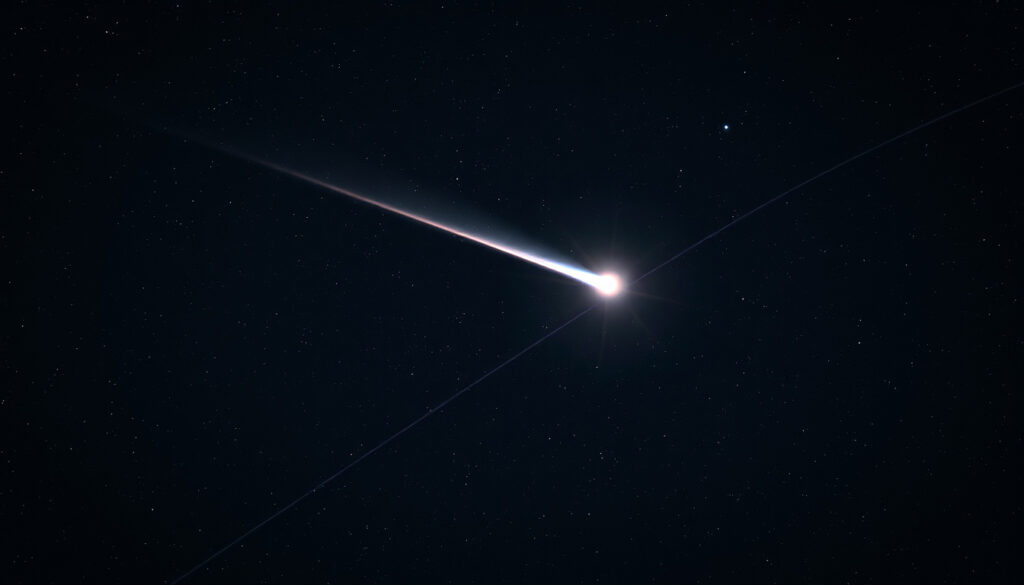
Interstellar Comet 3I/ATLAS: Facts, Orbit and Timeline
Every now and then, an object from another star system swings through our cosmic neighborhood, giving astronomers a rare chance to study a piece of another world. The latest visitor, interstellar comet 3I/ATLAS, was caught by the ATLAS survey on July 1, 2025, and has already sparked both scientific excitement and a fair share of internet speculation.
Discovery date: July 1, 2025 ·
Closest approach to Sun: October 30, 2025 ·
Distance at closest approach: 1.4 AU (210 million km) ·
Classification: Interstellar comet (second confirmed) ·
Status: No threat to Earth
Quick snapshot
- Interstellar origin confirmed by hyperbolic orbit (Star Walk)
- Discovered July 1, 2025 by ATLAS survey (Space.com)
- No impact risk to Earth (NASA Science)
- Exact diameter: estimated between 1,400 ft and 3.5 miles (Smithsonian)
- Whether the comet will fragment near perihelion (Smithsonian)
- Full volatile composition beyond deuterated water (Smithsonian)
- July 1, 2025: Discovery (Space.com)
- Oct 30, 2025: Perihelion at 1.4 AU (NASA Science)
- Dec 19, 2025: Closest approach to Earth (Star Walk)
- Comet will continue on hyperbolic exit trajectory (Smithsonian)
- Hubble and ground telescopes tracking until it fades (Smithsonian)
- Data analysis on deuterium ratio will refine origin story (Smithsonian)
The table below compiles nine verified parameters for the comet’s orbit, size, and trajectory.
| Parameter | Value |
|---|---|
| Discovery date | July 1, 2025 |
| Discovering survey | Asteroid Terrestrial-impact Last Alert System (ATLAS) |
| Perihelion date | October 30, 2025 |
| Perihelion distance | 1.4 AU (210 million km) |
| Orbital eccentricity | >1.0 (hyperbolic) |
| Estimated diameter | ~2 km (based on Hubble data) |
| Speed relative to Sun | ~25 km/s |
| Inclination | ~159 degrees |
| Status | No threat to Earth |
What does it mean that the 3I ATLAS is interstellar?
What distinguishes an interstellar comet from a solar system comet?
- Orbit shape: Interstellar comets travel on hyperbolic paths (eccentricity > 1) meaning they are not gravitationally bound to the Sun. Solar system comets have elliptical or barely hyperbolic orbits (Star Walk).
- Origin: 3I/ATLAS came from the direction of the constellation Sagittarius, likely ejected from another star system billions of years ago (Star Walk).
- Speed: Traveling at roughly 30 km/s relative to the Sun, its energy is too high to be captured into solar orbit (NASA YouTube).
Only two interstellar comets have been confirmed before: 1I/‘Oumuamua in 2017 and 2I/Borisov in 2019. 3I/ATLAS is the third such object and the second comet (Star Walk).
How do astronomers confirm an object is interstellar?
- The Minor Planet Center calculates the orbit and checks for hyperbolic eccentricity immediately (Star Walk (MPC notice)).
- Pre-discovery images from the Zwicky Transient Facility and ATLAS telescopes helped refine the trajectory (NASA YouTube).
- For 3I/ATLAS, the interstellar classification was confirmed within 24 hours of discovery, on July 2, 2025 (Star Walk).
Each interstellar visitor gives scientists a direct sample of planetesimal material from another star. The deuterium-heavy water in 3I/ATLAS—40 times the ratio found in Earth’s oceans and 30 times that of typical solar system comets—suggests it formed in an extremely cold region near the Milky Way’s center (Smithsonian). That discovery alone rewrites assumptions about where icy bodies can form.
The implication: 3I/ATLAS offers a rare window into the chemistry of a planetesimal born in a completely different stellar environment, not just a passing curiosity.
Key takeaway: Astronomers now have direct isotopic evidence that interstellar planetesimals can form in extremely cold regions of the galaxy, fundamentally changing models of planetary system formation.
Where is the Interstellar Comet 3I ATLAS now?
What is the current position and velocity of 3I/ATLAS?
- At discovery, the comet was about 670 million km from the Sun, within Jupiter’s orbit (NASA YouTube).
- Its trajectory is hyperbolic and it is now receding from the Sun after perihelion (Star Walk).
- 3I/ATLAS crossed beyond Jupiter’s orbit in March 2026 and continues its exit from the solar system (Star Walk).
When will 3I/ATLAS reach its closest point to the Sun?
- Perihelion occurred on October 30, 2025, at a distance of 1.4 AU (210 million km), well inside Mars’s orbit (NASA Science).
- After perihelion, the comet began its long journey back into interstellar space, never to return.
The pattern: 3I/ATLAS swept through the inner solar system in a matter of months, giving observers a narrow window to gather data before it disappeared into the void.
Will the comet 3I ATLAS be visible from Earth?
Can I see 3I/ATLAS with a telescope or binoculars?
- The comet has never been expected to reach naked-eye brightness. It was discovered at magnitude 20 (Star Walk).
- During its closest approach to Earth on December 19, 2025, it may have become visible through moderate-sized amateur telescopes (8-inch or larger) under dark skies (NASA Science).
When is the best time to observe 3I/ATLAS?
- Ground-based telescopes observed it through September 2025, then it reappeared in early December 2025 after passing behind the Sun (NASA Science).
- Its brightness evolution has been unpredictable, with some outbursts reported (Space.com).
For most skywatchers, 3I/ATLAS was never an easy target. But the comet’s unpredictable brightening kept the astronomical community alert, and the science gained from professional observations far outweighs what the eye can see.
What this means: if you missed it, the real show was always in the data, not the sky.
What happens if the 3I ATLAS hits Earth?
Could 3I/ATLAS actually collide with Earth?
- NASA’s Planetary Defense Coordination Office has tracked its orbit and confirms there is no risk of impact. The minimum distance to Earth was 1.6 AU (150 million miles) (NASA Science).
- The comet’s trajectory does not intersect Earth’s orbit at any point.
What would be the consequences of an impact?
- With an estimated diameter of about 2 km, an impact would cause regional devastation (on the scale of a large volcanic eruption) but not a global extinction event (Smithsonian).
- For context, the object that ended the Cretaceous period was about 10 km.
The trade-off: even though this comet is harmless, its discovery tests our detection systems. A larger interstellar object on a collision course would give us far less warning.
Should Earth be worried about the 3I ATLAS?
Why are scientists not concerned about 3I/ATLAS?
- Its orbit is well understood and safe. NASA Science states flatly: “There is no danger to Earth from this comet; its orbit is well understood and does not intersect our planet” (NASA Science).
- Misinformation spread on social media claiming it was an alien spacecraft, but the scientific community dismissed those claims based on standard cometary activity like its coma (Space.com).
What about other interstellar objects?
- Detection systems like ATLAS, Pan-STARRS, and the future Vera Rubin Observatory are designed to identify any threatening object years in advance.
- If a future interstellar visitor were found on a collision course, international planetary defense measures could be activated.
The real risk is not this comet but the next one. 3I/ATLAS proves that interstellar objects are not rare—and our ability to detect them early is still being built.
The implication: fear is misplaced. Instead, 3I/ATLAS should be celebrated as a free scientific sample from another star system.
Timeline
- July 1, 2025: Discovery by ATLAS survey in Chile (Space.com)
- July 2, 2025: Interstellar status confirmed by Minor Planet Center (Star Walk)
- July – October 2025: Intensive observations by Hubble and ground telescopes (NASA YouTube)
- October 30, 2025: Perihelion at 1.4 AU (NASA Science)
- December 19, 2025: Closest approach to Earth (Star Walk)
- March 2026: Crosses Jupiter’s orbit, exiting solar system (Star Walk)
Clarity check
Confirmed facts
- Interstellar origin (hyperbolic orbit)
- Discovery date and survey (ATLAS)
- No impact risk with Earth
- Closest approach date and distance
- Detection of deuterium-rich water
What’s unclear
- Exact diameter (range 1–3 km)
- Will the comet fragment during perihelion?
- Precise composition of other volatiles
- How its behavior compares to 2I/Borisov
In their own words
“We hope to gain a deeper understanding of how planetesimals and planets formed in a wide variety of stellar systems, including our own.”
— Lead researcher from the 3I/ATLAS observing campaign (Space.com)
“There is no danger to Earth from this comet; its orbit is well understood and does not intersect our planet.”
— NASA spokesperson (NASA Science)
For the astronomical community, the takeaway is straightforward: 3I/ATLAS is a gift, not a threat. The data gathered on its deuterium-heavy water and hyperbolic trajectory will inform models of planet formation across the galaxy for years.
Detailed observations from space telescopes, including Hubble images and key facts, have helped refine its trajectory.
Frequently asked questions
What is the difference between 3I/ATLAS and 2I/Borisov?
Both are interstellar comets, but 2I/Borisov (2019) was larger and more active, with a clear dust tail. 3I/ATLAS is smaller and its coma has been more subdued, though it surprised observers with a deuterium ratio much higher than Borisov’s (Star Walk).
How was 3I/ATLAS discovered?
The ATLAS survey telescope in Rio Hurtado, Chile, detected it on July 1, 2025. The Minor Planet Center announced its interstellar designation the next day.
What instruments are observing the comet?
Major observatories include the Hubble Space Telescope, the Zwicky Transient Facility, and ground-based optical telescopes around the world (NASA YouTube).
What are scientists hoping to learn from 3I/ATLAS?
Key goals include understanding the chemical composition of an interstellar planetesimal, especially its water isotopes, to infer the conditions in its parent star system (Smithsonian).
Has 3I/ATLAS changed in brightness or appearance?
Yes, it has shown unpredictable brightening episodes, which may indicate outgassing or fragmentation events (Space.com).
Could there be more interstellar comets like this?
Absolutely. Current surveys are discovering more interstellar objects than expected. The upcoming Vera Rubin Observatory will likely find dozens per year.
How fast is 3I/ATLAS traveling?
Its speed relative to the Sun is about 30 km/s (67,000 mph) (Star Walk).
Related reading
More related posts
 PVC Bathroom Wall Panels: Benefits, Costs & Install
 Brentford vs Nottm Forest – Preview, Prediction and Lineups
 Norwich City vs Southampton: H2H, Prediction, Lineups
 BBC Weather Market Drayton – Hourly and 14-Day Forecast
 Amlodipine Is Killing Me – Side Effects, Risks and Alternatives
 18 Stone in Lbs – Exact Conversion Guide and Charts
 Pharmacy First Scheme Near Me – Find Participating Pharmacies
 BBC Radio 5 Live Sports Extra: How to Listen UK & Abroad