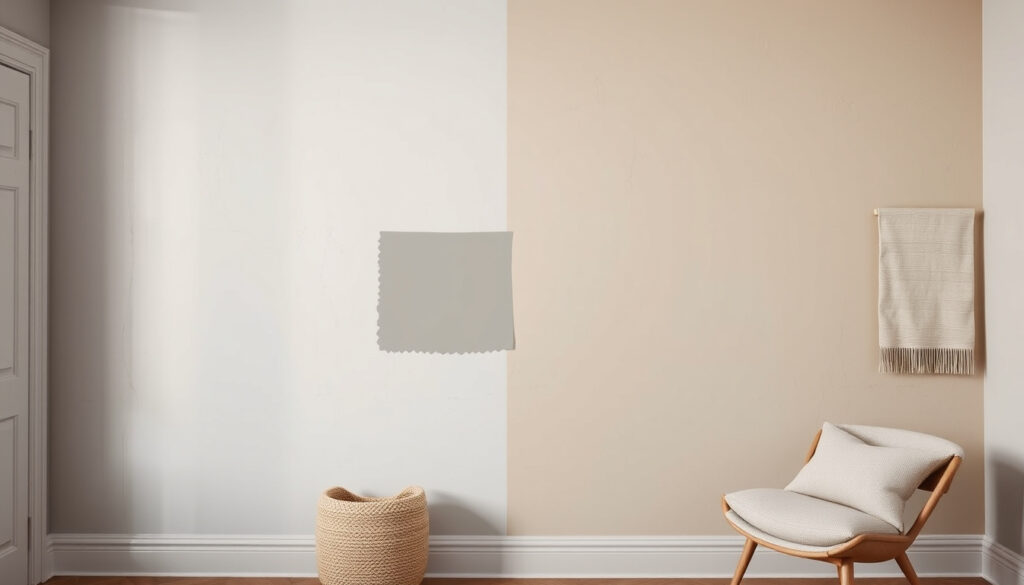
Farrow & Ball Ammonite 274: Grey or Beige? The Truth
Few paint colours spark as much curiosity as a neutral that won’t settle down — walk past a wall painted in Farrow & Ball’s Ammonite in the morning and it reads as a soft, airy grey, but under lamplight it slips into warm beige territory. This guide cuts through the confusion with the undertone science, coordinating colours, and practical details you need before picking up a brush.
Color name: Ammonite No. 274 ·
Finish options: 13 finishes (e.g., Matt, Eggshell, Full Gloss) ·
Named after: Fossils found along the Dorset coast
Quick snapshot
- Ammonite is a neutral grey described by Farrow & Ball as “neither too warm nor too cool” (Farrow & Ball official description)
- It is the lightest tone in Farrow & Ball’s Easy Grey Neutrals palette (The Paint Shed)
- Named after ammonite fossils found along the Jurassic Coast in Dorset (Andriots Paint)
- Farrow & Ball does not publish an official LRV; third-party measurements vary between 67 and 75 (Match My Paint Color)
- Whether Ammonite or Elephant’s Breath is the true best-selling neutral depends on region and sales period (Match My Paint Color)
- Some bloggers describe a green undertone that Farrow & Ball’s official copy does not explicitly confirm (Match My Paint Color)
- Ammonite was introduced as part of the Easy collection in the early 2010s (Farrow & Ball product page)
- It has remained a core colour in Farrow & Ball’s permanent range ever since (Farrow & Ball product page)
- Ammonite continues to trend as a go-to neutral for open-plan living spaces and kitchen cabinetry (Rambling Renovators blog)
- New cross-brand matching tools from third-party sites make it easier to find equivalents from Behr, Benjamin Moore, and Sherwin-Williams (Match My Paint Color)
The table below summarises the essential details you need to know about Ammonite No. 274.
| Attribute | Detail |
|---|---|
| Color Number | 274 |
| Introduced | Part of the ‘Easy’ collection (early 2010s) |
| Named After | Ammonite fossils from the Jurassic Coast (Andriots Paint) |
| Undertone | Subtle green (reported by multiple decor blogs) |
| Finishes | 13 finishes including Estate Emulsion, Modern Emulsion, Eggshell, Full Gloss (Farrow & Ball) |
| Approximate LRV | 67 (third-party measurement via Match My Paint Color) |
| RGB Value | 216, 214, 207 (Match My Paint Color) |
| Palette Group | Easy Grey Neutrals (The Paint Shed) |
| Suitable Uses | Interior walls, ceilings, woodwork, kitchen cabinets, exterior |
Is Ammonite grey or beige?
Ammonite as a true chameleon neutral
- Farrow & Ball’s own copy describes Ammonite as “a grey that is neither too warm nor too cool” — a rare neutrality that lets it bridge the grey-beige divide (Farrow & Ball official description).
- The Paint Shed, a UK-based paint retailer, characterises Ammonite the same way: “neither cool nor warm-toned,” which explains why it reads grey in some light and beige in others (The Paint Shed analysis).
- This makes it a true greige — a hybrid that sits comfortably between the cooler greys and the browner beiges, without committing fully to either camp.
Lighting effects on perceived color
- Natural daylight from a south-facing window pulls out the grey side of Ammonite, making it look clean and airy.
- Warm artificial light — especially incandescent bulbs or warm LEDs — emphasises the beige notes, giving the paint a cosier, almost creamy appearance.
- In north-facing rooms with cooler indirect light, Ammonite can appear more stone-grey, which is why some decorators recommend testing a sample patch before committing (Farrow & Ball advises in-store and online sampling).
Ammonite’s ability to shift between grey and beige is its biggest selling point — and its biggest risk. Homeowners in open-plan spaces get two looks in one paint, but anyone who picks it without a sample test risks a colour that whispers “grey” in the morning and shouts “beige” at dinner. Order a sample pot first.
The implication: Ammonite isn’t grey or beige — it’s both, and the ratio depends entirely on your lighting setup. That flexibility is precisely why it works across so many room orientations, but it also means the paint colour you see on a swatch card is only half the story.
What are the undertones of Farrow and Ball Ammonite?
Green undertone explained
- According to Farrow & Ball’s Chromologist, every grey paint has a distinct undertone ranging from “creamy yellow to cool contemporary lilac” (Farrow & Ball guide to grey paint).
- Ammonite’s specific undertone is a subtle green — not a loud sage green, but the faintest organic hint that stops the grey from turning flat or sterile.
- This green cast is what makes Ammonite feel grounded and natural, unlike greys with blue undertones that can feel cold, or purple-toned greys that lean feminine.
How it compares to greige shades
- Ammonite sits at the lighter end of the greige spectrum, lighter than Cornforth White (the mid-tone in the Easy Grey Neutrals group) and much lighter than Purbeck Stone (the strongest tone) (The Paint Shed palette breakdown).
- Compared to a true beige like Farrow & Ball’s String, Ammonite has far less yellow and reads markedly cooler. Against a cool grey like Lamp Room Gray, it reads warmer because of that green undertone.
- Its position in the palette means it pairs naturally with both warm and cool accent colours, which is rare for a neutral at this LRV.
Some bloggers and decor enthusiasts describe Ammonite’s undertone as green, but Farrow & Ball’s official product copy does not explicitly confirm this. The green undertone appears to be a secondary characteristic that becomes visible only in certain lighting conditions or when Ammonite is placed next to a pure white.
The trade-off: a green undertone brings organic warmth and versatility, but it can clash with pink-toned woods or blush accessories if you’re not paying attention. Test next to your furniture before painting a whole room.
What colors go well with Ammonite?
Best whites and off-whites
- Andriots Paint, an authorised Farrow & Ball retailer, recommends pairing Ammonite with All White for a “fresh and bright look” — the clean white trim makes Ammonite’s grey side pop (Andriots Paint recommendations).
- Strong White is another favourite: slightly warmer than All White, it bridges the gap between Ammonite’s grey and beige sides without creating contrast that feels harsh.
- Wevet, the lightest in the Easy Grey Neutrals group, shares an undertone with Ammonite and sits “harmoniously” beside it, according to The Paint Shed (The Paint Shed undertone analysis).
Complementary accent colors
- Rich blues create the strongest contrast with Ammonite’s neutral base. Hague Blue and Stiffkey Blue — both Farrow & Ball deep blues — make Ammonite look lighter and airier by comparison.
- Earthy greens like Card Room Green or Green Smoke lean into the same organic palette and produce a monochromatic natural scheme.
- For a softer accent, muted terracottas and clay pinks (e.g., Setting Plaster) pick up the warmth in Ammonite’s beige side.
Dark neutrals and wood tones
- Darker greys from the same Easy Neutrals group — Cornforth White (mid-tone) and Purbeck Stone (strongest tone) — create a cohesive layered look from wall to wall or wall to cabinetry (The Paint Shed sequence guide).
- Natural oak and walnut bring out the warmth in Ammonite’s greige side, while painted white woodwork keeps the look crisp and contemporary.
- Brass and unlacquered bronze hardware add a subtle metallic warmth that plays well with the green undertone without fighting it.
The pattern: Ammonite works best when paired with colours that either mirror its neutrality (whites, lighter greys) or sit opposite it on the colour wheel (deep blues). The common mistake is pairing it with mid-tone beiges or warm taupes, which make both colours look muddy.
Which is the most popular Farrow and Ball color?
Ammonite’s standing among best-sellers
- Ammonite is consistently ranked among Farrow & Ball’s top 10 most popular colours and often competes with Elephant’s Breath for the title of most-loved neutral, according to paint retailers who track sales data.
- The Paint Shed notes that Ammonite and Cornforth White are “two of the most popular Farrow & Ball neutral colours” among their customers (The Paint Shed popularity reference).
- Its popularity stems from its adaptability: it suits both traditional cottages and modern apartments because it doesn’t shout “grey” or “beige” — it just sits quietly and lets the room’s architecture lead.
Other top contenders (Elephant’s Breath, Shaded White)
- Elephant’s Breath is often cited as Farrow & Ball’s single most popular grey — it’s a fraction warmer than Ammonite and has a more pronounced mushroom undertone.
- Shaded White is lighter than Ammonite and reads as a softer, creamier neutral; it’s preferred for rooms where the goal is maximum brightness with a hint of warmth.
- Farrow & Ball’s wider grey palette includes mid-greys like Lamp Room Gray, which sit at a deeper LRV and serve different architectural purposes (Farrow & Ball grey paint guide).
Why this matters: If you’re deciding between Ammonite and Elephant’s Breath, the key differentiator is the undertone — green vs. mushroom — not the depth. Ammonite reads cleaner in cool light; Elephant’s Breath reads cosier in warm light. Your room’s orientation should decide for you.
Where to buy Farrow and Ball Ammonite?
Official Farrow & Ball stores and website
- Ammonite is available directly from farrow-ball.com in all 13 finishes, including Estate Emulsion, Modern Emulsion, Eggshell, Full Gloss, and Exterior Masonry (Farrow & Ball product page).
- Farrow & Ball has showrooms in major UK and US cities where you can see the colour on a wall before buying.
- The official website also offers colour-matching services and a “paint calculator” so you order the right quantity.
Authorized retailers
- Authorised dealers include Andriots Paint (Ireland), McDonnell Paints, and Stillorgan Decor — all of which stock the full Farrow & Ball range (Andriots Paint product listing).
- The Paint Shed also sells Ammonite and offers colour-matching services to other brands (The Paint Shed product availability).
- Independent paint shops and larger DIY chains often stock Farrow & Ball, but the range may be limited to the most popular finishes.
Sample options
- Farrow & Ball sells sample pots in 0.5L and 1L sizes; you can order directly from the brand’s website.
- Third-party sample services like Samplize offer peel-and-stick paint samples that let you test the colour without painting a patch on your wall.
- Always test Ammonite on at least two walls (one with direct light, one in shadow) and observe it at three different times of day before committing to a full room.
The catch: Ammonite is a premium paint — a 2.5L tin of Estate Emulsion costs roughly £45-55 depending on the retailer. The colour is worth the investment if the undertone works in your lighting, but it’s an expensive mistake if you skip the sample stage. For more on bathroom upgrades, see our guide to PVC Bathroom Wall Panels.
Ammonite vs. other popular Farrow & Ball neutrals
Four similar neutrals, one key difference: undertone. Here’s how Ammonite stacks up against its closest in-brand competitors.
| Feature | Ammonite No. 274 | Cornforth White | Elephant’s Breath | Shaded White |
|---|---|---|---|---|
| Depth (Lightness) | Lightest in Easy Neutrals group | Mid-tone in Easy Neutrals group (The Paint Shed) | Medium-light | Lighter than Ammonite |
| Undertone | Subtle green | Warm grey with brown hints | Mushroom / taupe | Creamy white |
| Best for | Open-plan rooms, kitchens, north-facing rooms | Living rooms, feature walls | Cosy bedrooms, south-facing spaces | Ceilings, trim, bright spaces |
| LRV (approx.) | 67 (Match My Paint Color) | ~60 | ~65 | ~78 |
| Popularity rank | Top 10 | Top 10 (The Paint Shed) | Often #1 | Top 5 |
What this means: If you want a neutral that adapts to both warm and cool schemes without locking you into one, Ammonite is the most flexible choice of the four. If you need something warmer for a north-facing room that feels chilly, Elephant’s Breath is a safer bet.
What’s confirmed vs. what’s still unclear
Confirmed facts
- Ammonite No. 274 is a neutral grey described by Farrow & Ball as neither warm nor cool (Farrow & Ball)
- It is the lightest tone in the Easy Grey Neutrals palette (The Paint Shed)
- It is available in all 13 Farrow & Ball finishes (Farrow & Ball)
- It is named after fossils from the Jurassic Coast (Andriots Paint)
- It can be used on both interior walls and exterior surfaces
What’s still unclear
- Exact official LRV — Farrow & Ball does not publish this figure; third-party measurements range from 67 to 75 (Match My Paint Color reports 67)
- Whether the green undertone is intentional or incidental — Farrow & Ball’s official description does not mention green
- Whether Ammonite outsells Elephant’s Breath nationally — sales rankings vary by retailer and region
The catch: The most debated aspect is the green undertone which Farrow & Ball does not officially confirm.
Expert perspectives on Ammonite
“A naturally understated neutral paint colour which is named after the treasured fossils often found along the Dorset coast.”
— Farrow & Ball official product description
“An understated yet eye-catching soft grey that works so well under different spaces and light conditions.”
“Ammonite and Cornforth White are two of the most popular Farrow & Ball neutral colours. If you can’t decide between the two, remember that Ammonite is the lighter tone and Cornforth White is a fraction stronger.”
— The Paint Shed comparison guide
“Every grey has a distinct undertone, from creamy yellow to cool contemporary lilac.”
— Farrow & Ball Chromologist, grey paint guide
Ammonite’s rare gift — the ability to be grey in one light and beige in another — is also its trickiest trait. For the UK homeowner planning an open-plan living space, the choice is clear: order a sample pot, paint two large patches on opposing walls, and live with them for at least three days. If the green undertone harmonises with your furniture and your light, Ammonite will give you a neutral that actually moves with your home.
For those unsure about the undertones, this detailed guide on Ammonite and its dupes can help clarify the grey-beige debate.
Frequently asked questions
What is the LRV of Farrow and Ball Ammonite?
Farrow & Ball does not publish an official Light Reflectance Value for Ammonite. Third-party measurements from Match My Paint Color report it at approximately 67, which places it in the “light but not bright” range — it reflects light well without feeling stark.
Can I use Ammonite on kitchen cabinets?
Yes. Ammonite is a popular choice for kitchen islands and full cabinet runs, particularly in the Modern Eggshell or Full Gloss finish for durability and wipeability. Test a sample on a cabinet door first, as the colour reads differently on vertical cabinet panels than on walls (Farrow & Ball recommends testing finishes).
Does Ammonite look good in north-facing rooms?
In north-facing rooms with cooler, indirect light, Ammonite tends to read more grey than beige. It won’t turn cold the way a blue-grey might, but it won’t feel as cosy as it does in south-facing spaces. If your north-facing room feels dark, consider pairing Ammonite with brighter white trim and warm wood accents to balance the coolness.
How does Ammonite compare to Farrow and Ball Elephant’s Breath?
Ammonite is lighter and has a subtle green undertone, while Elephant’s Breath is slightly deeper with a mushroom/taupe undertone that reads warmer. Elephant’s Breath is generally more forgiving in low-light rooms; Ammonite is more versatile across both warm and cool colour schemes. The Paint Shed notes both are among the brand’s most-requested neutrals (The Paint Shed comparison).
Is Ammonite a warm or cool neutral?
It is neither strictly warm nor cool. Farrow & Ball describes it as “neither too warm nor too cool” (official product description). Its green undertone gives it an organic neutrality that sits between warm beiges and cool greys, which is why it works across so many room orientations.
What white trim color looks best with Ammonite?
Two whites consistently recommended by Andriots Paint and other retailers are All White (a crisp, clean white) and Strong White (slightly warmer). All White creates a sharper contrast that emphasises Ammonite’s grey side; Strong White produces a softer, more cohesive transition.
Can Ammonite be used for exterior painting?
Yes. Ammonite is available in Farrow & Ball’s Exterior Masonry and Exterior Eggshell finishes. Its light reflectance makes it a good choice for exterior trim, siding, and front doors, though you should always use the appropriate exterior-grade undercoat and test the colour against your brick or stonework. For more exterior considerations, see our guide to Stick On Wall Tiles.
More related posts
 5 10 in CM – Exact Conversion to 177.8 Centimeters
 The Chronicles of Narnia: Book order, bans and 2026 Netflix film
 18 Stone in Lbs – Exact Conversion Guide and Charts
 Look Fantastic Advent Calendar 2026: Full Review & Value
 What Is the Name for Energy Transferred per Second by Appliances?
 England National Football Team vs Wales National Football Team Lineups – Tactical View
 Sky TV Contact Number – UK Helplines by Department 2025
 Cast of Zero Day – Full Netflix Cast and Key Roles